
The Major Reasons (Ranked by Impact)
1️⃣ Hepatology Isn’t a Formal Board Specialty
- Hepatology is a sub-subspecialty of GI, not a standalone board-certified specialty.
- You have to:
- Complete Internal Medicine
- Complete GI fellowship
- Then do additional transplant/hepatology training
- Many physicians stop at GI because there’s no credentialing upside to going further.
👉 Result: Massive leakage in the pipeline.
2️⃣ Procedural GI Pays Much More
- General GI = scopes, procedures, ASC ownership, predictable schedules.
- Hepatology = mostly cognitive care, longitudinal management, complex patients.
3️⃣ Transplant-Centered Training Bottleneck
- Many hepatologists are trained only at transplant centers.
- Limited number of programs → limited number of fellows.
- Training emphasizes inpatient, end-stage disease, not scalable outpatient care.
4️⃣ Emotionally & Clinically Hard Work
- Patients are often:
- Very sick
- Socioeconomically complex
- Struggling with addiction, obesity, diabetes
- Outcomes can be slow, and relapses common.
Burnout risk is higher than general GI.
5️⃣ Poor Geographic Distribution
- Hepatologists cluster around:
- Academic centers
- Transplant hospitals
- Large swaths of the U.S. have zero hepatology access.
Some states have:
- 1 hepatologist per 500k–1M people
- Rural areas: none
6️⃣ Explosion in Liver Disease Outpaced Workforce Growth
- NAFLD/NASH prevalence exploded without new workforce planning.
- ~40% of U.S. adults have fatty liver.
- Hepatology workforce grew incrementally, not exponentially.
👉 Demand grew 10×. Supply grew ~1–2×.
The Numbers (Approximate but Directionally Accurate)
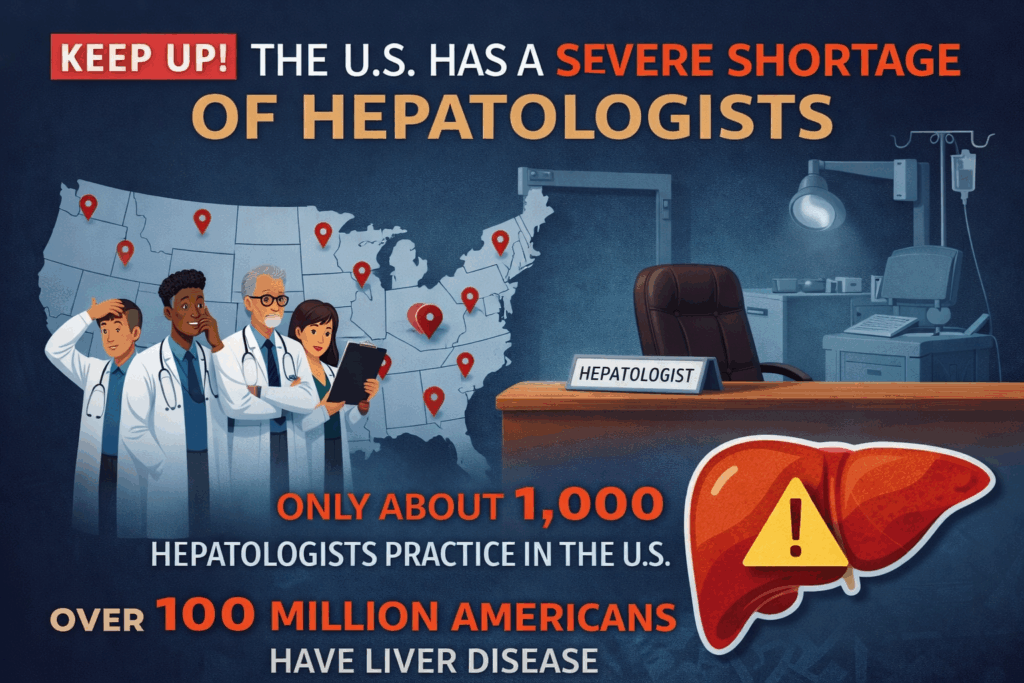
- ~1,500–2,000 practicing hepatologists in the U.S.
- vs 100M+ adults with fatty liver
- Effective ratio: ~1 hepatologist per 50,000–70,000 liver patients
That’s structurally impossible.
Why This Won’t Self-Correct
Even with new drugs coming:
- Training pipeline remains slow
- Reimbursement still favors procedures
- No board certification incentive
- Burnout risk remains high
👉 The market cannot fix this on its own.
What Actually Solves the Gap (Spoiler: Not More Hepatologists)
- Virtual hepatology such as from LiverRight
- Task-shifting to PCPs, NPs, PAs with hepatology support
- AI-driven identification & risk stratification
- Protocolized care pathways
- Hub-and-spoke + national reach
The U.S. doesn’t have a hepatology shortage — it has a hepatology delivery model problem. Which is what we have built and are iterating nationwide here at LiverRight.