
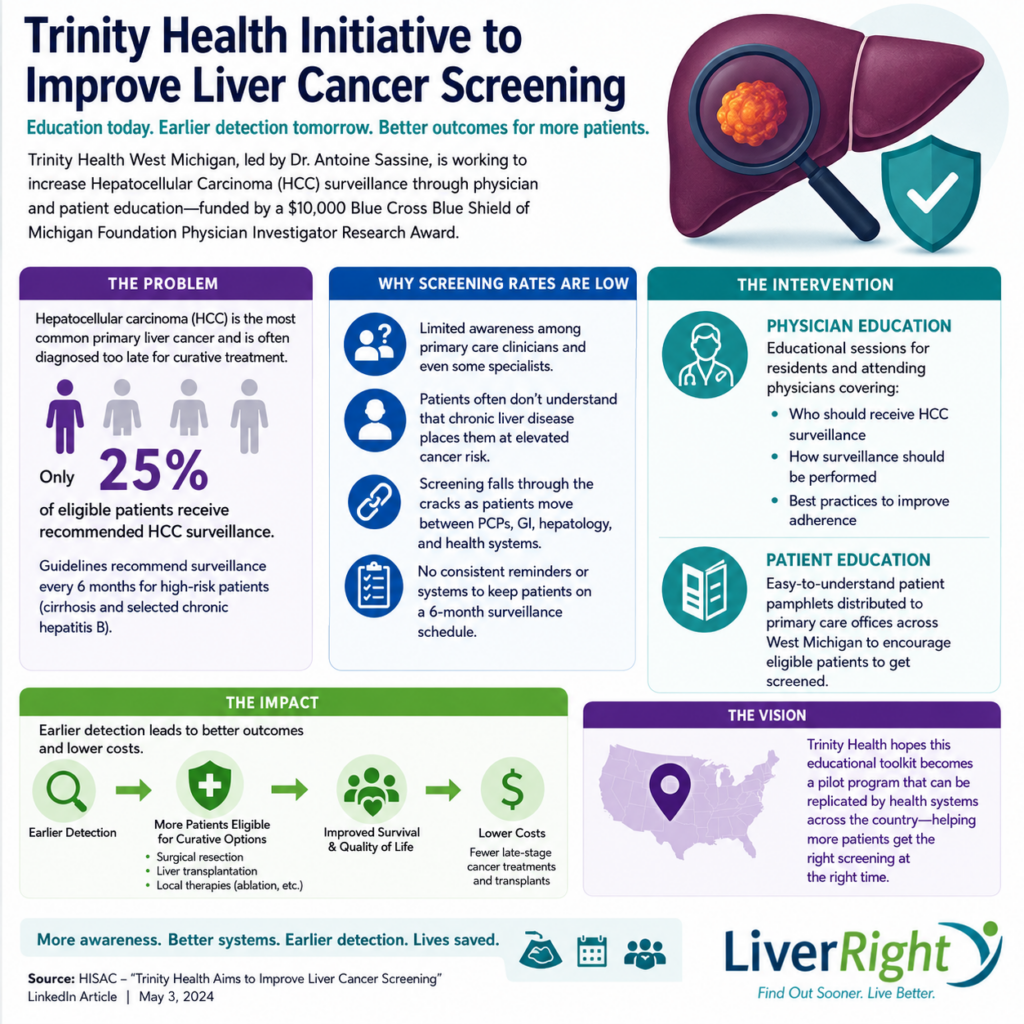
The LinkedIn article titled “Trinity Health Aims to Improve Liver Cancer Screening Rates Through Physician, Patient Education Intervention” highlights a small but potentially high-impact initiative by Trinity Health West Michigan to improve hepatocellular carcinoma (HCC) surveillance through provider and patient education. The project is led by Dr. Antoine Sassine, a Trinity Health physician, and funded by a $10,000 Blue Cross Blue Shield of Michigan Foundation Physician Investigator Research Award.
Key points
- The problem
- HCC is the most common primary liver cancer and is often diagnosed too late for curative treatment.
- Although professional societies recommend surveillance every 6 months for appropriate high-risk patients (primarily those with cirrhosis and selected patients with chronic hepatitis B), only about 25% of eligible patients actually receive recommended surveillance.
- Why screening rates are low
- Limited awareness among primary care clinicians and even some specialists.
- Patients often don’t understand that chronic liver disease places them at elevated cancer risk.
- Screening falls through the cracks as patients move between PCPs, GI, hepatology, and health systems.
- The intervention
- Educational sessions for physicians (residents and attending physicians) covering:
- Who should receive HCC surveillance
- How surveillance should be performed
- Best practices to improve adherence
- Development of easy-to-understand patient pamphlets distributed to primary care offices throughout West Michigan to encourage eligible patients to obtain surveillance.
- Educational sessions for physicians (residents and attending physicians) covering:
- Expected impact
- Earlier detection means more patients qualify for:
- Surgical resection
- Liver transplantation
- Curative local therapies (ablation, etc.)
- Earlier treatment improves survival while reducing the need for expensive late-stage cancer care and transplantation.
- Earlier detection means more patients qualify for:
- Long-term vision
- Trinity hopes the educational toolkit becomes a pilot program that can be replicated by health systems across the country.