
The shortage of livers for transplant in the U.S. happens mainly because demand is far greater than the supply of usable donor organs. Several medical, social, and logistical factors contribute to this gap.
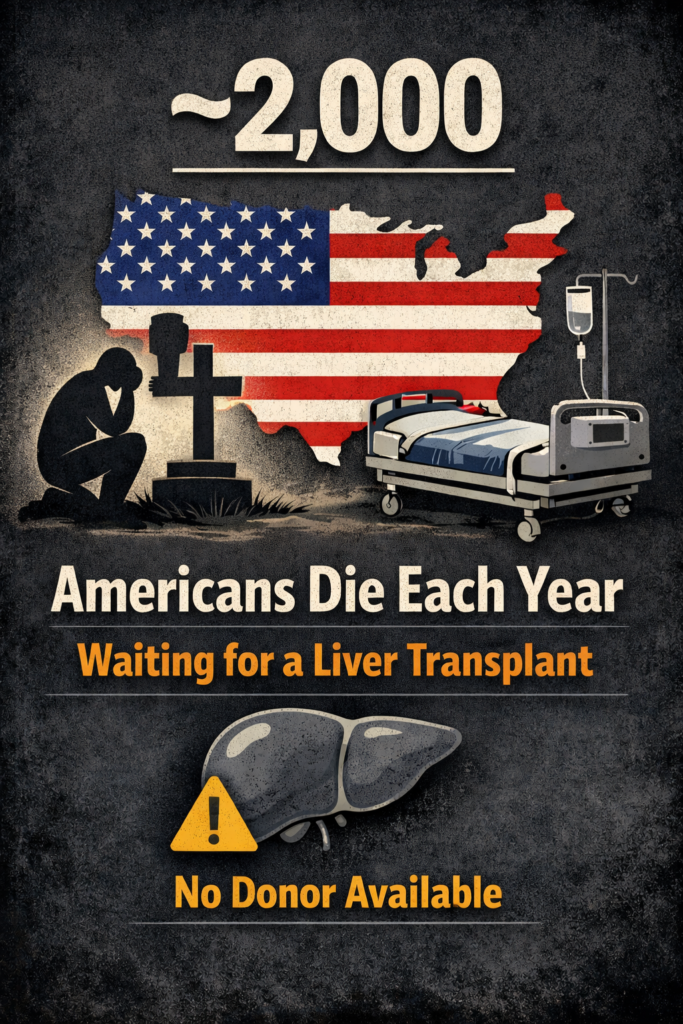
Identifying liver disease in earlier stages will help address the fact that patients die waiting for an organ. Liver disease identified in F1/F2, as an example, is highly treatable, such that Liver Cancer and/or a Liver Transplant can be avoided.
The Why–
1. Far More People Need Livers Than Are Donated
- Over 100,000 people in the U.S. are on the organ transplant waiting list at any given time.
- Many of them need a liver because of cirrhosis, cancer, or acute liver failure.
- 13 people die each day waiting for an organ that never becomes available.
Even though liver transplants have increased (over 10,000 liver transplants in 2023), demand still exceeds supply.
2. Most Organs Can Only Come From Deceased Donors
Unlike kidneys (which can be donated by living donors), most liver transplants rely on people who die in specific medical circumstances.
For a liver to be usable:
- The donor must usually be brain-dead but still on life support
- The liver must be healthy enough
- The death must occur in a hospital where donation is possible
Only a small fraction of deaths meet these criteria.
3. Not Everyone Registers as an Organ Donor
Many people support organ donation but never formally register.
Reasons include:
- Lack of awareness
- Cultural or religious concerns
- Mistrust of the healthcare system
- Families refusing donation at the time of death
This reduces the potential donor pool.
4. Many Donated Organs Cannot Be Used
Even when organs are donated:
- Some livers are damaged by disease, infection, or fat (steatosis).
- Others become unusable due to long transport times or poor preservation.
So the number of usable organs is smaller than the number donated.
5. Liver Disease Is Increasing
Demand is rising because liver disease is becoming more common.
Major drivers include:
- Alcohol-associated liver disease (now the leading cause on the transplant waitlist)
- Fatty liver disease (MASLD/NASH) from obesity and diabetes
- Viral hepatitis complications
- Liver cancer
More patients are being added to transplant lists each year.
6. Matching Constraints
A liver cannot go to just anyone on the list. It must match on factors like:
- Blood type
- Body size
- Medical urgency
- Geographic logistics (time to transplant)
These constraints mean that some organs cannot be used for certain patients even if they are waiting.
7. System and Logistics Issues
The transplant system involves hospitals, organ procurement organizations, and transport logistics.
Sometimes organs are discarded because they cannot be matched or delivered in time.
Policy reforms are ongoing to increase organ utilization.