The 10/14/2026 article titled “Recompensation may represent a new treatment-related state in cirrhosis” was published by the American Association for the Advancement of Science (AAAS).
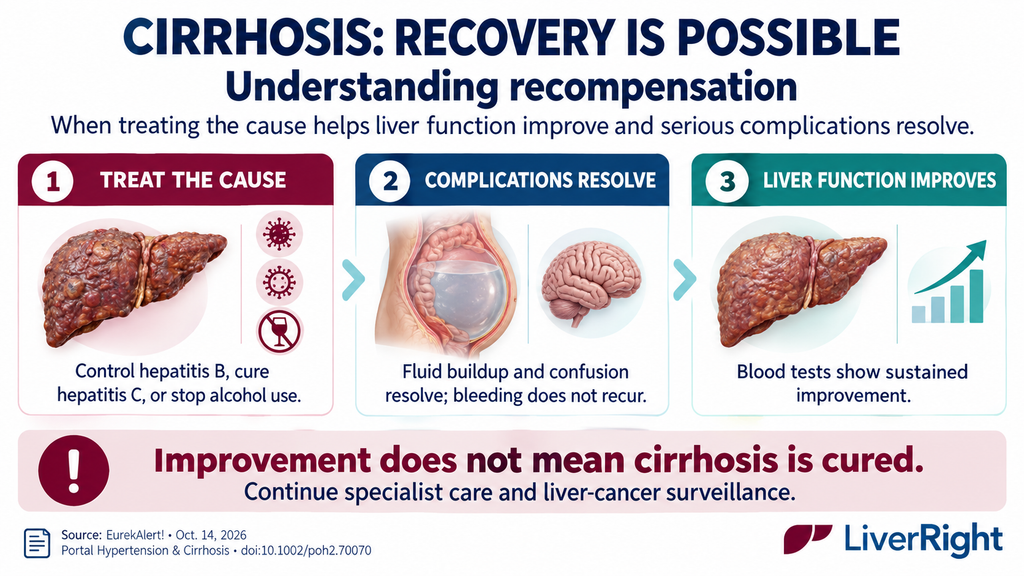
Recompensation means that someone whose cirrhosis caused serious complications improves enough for those complications to resolve and liver function to recover after the underlying cause is treated. It is a meaningful recovery, although cirrhosis and its risks may remain.
The terms describe three different situations:
| Term | Plain-English meaning |
|---|---|
| Compensated cirrhosis | The liver is severely scarred but still manages its essential work, without major complications. |
| Decompensated cirrhosis | Major complications develop, such as abdominal fluid buildup (ascites), confusion from toxin buildup (hepatic encephalopathy), or bleeding from enlarged veins. |
| Recompensated cirrhosis | After treatment of the underlying cause, those complications resolve and liver function improves in a sustained way. |
These distinctions come from the international Baveno consensus. Its established recompensation criteria include control of the cause—for example, curing hepatitis C, suppressing hepatitis B, or sustained alcohol abstinence—resolution of ascites and encephalopathy without their supporting medications, no recurrent variceal bleeding for at least 12 months, and sustained improvement in albumin, bilirubin and INR. Medication withdrawal requires clinical supervision.
The article’s main message is that recovery after advanced liver disease deserves more precise recognition. The October 14 release describes a perspective paper arguing that recompensation should be recognized as a distinct state after treatment. Some patients achieve lasting recovery; others improve but remain vulnerable to further complications.
The authors propose four categories: compensated cirrhosis, stable recompensation, unstable recompensation, and persistent decompensation. Their purpose is to help doctors describe prognosis, plan follow-up and compare patients in research more accurately. This is a proposed framework requiring further validation, rather than a trial of a new treatment.
The encouraging takeaway: even after cirrhosis causes serious complications, meaningful recovery is possible. However, patients who recompensate can retain risks of renewed decompensation and liver cancer, so continued specialist care and surveillance remain necessary.