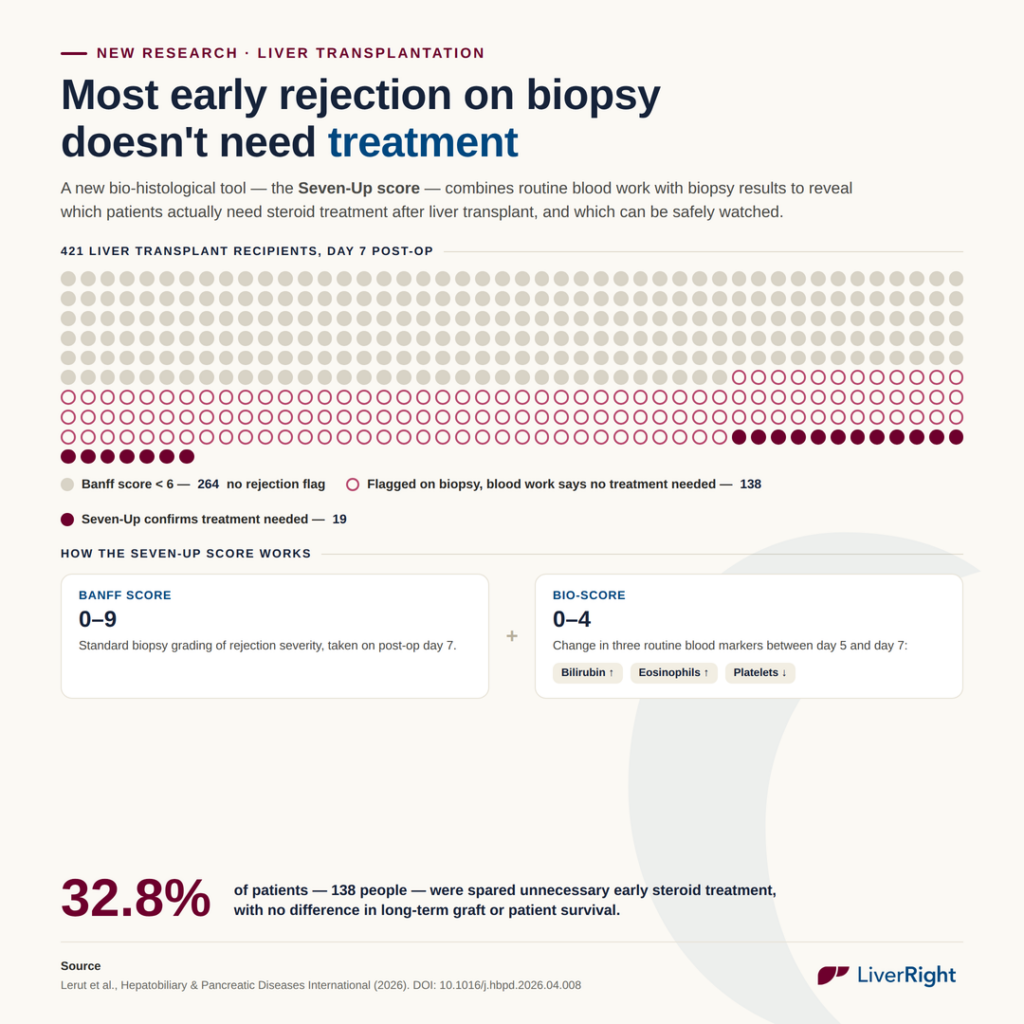
This June 2026 article in Hepatobiliary & Pancreatic Diseases International titled “Combined Bio-histological assessment as a tool to refine diagnosis and avoid overtreatment of early T cell-mediated rejection after liver transplantation” is worth considering.
The problem: After a liver transplant, doctors do a biopsy to check for early signs of organ rejection. But the standard scoring system (called “Banff”) only looks at what the tissue looks like under a microscope — and it turns out a lot of what looks like rejection on biopsy doesn’t actually need treatment. Treating it anyway means giving patients high-dose steroids they didn’t need, which comes with real downsides (infections, diabetes, heart and kidney problems).
What the researchers did: A team in Brussels followed 421 adult liver transplant patients and built a new scoring tool called the “Seven-Up score.” It combines two things measured around day 7 after transplant:
- The biopsy result (the usual Banff score)
- A “Bio-score” based on three simple blood tests: rising bilirubin, rising eosinophils (a type of white blood cell), and a dropping platelet count
What they found: Using biopsy results alone, 37% of patients would have been flagged for treatment. But when you added the blood-test criteria, only 4.5% actually needed it. That means roughly a third of patients could safely skip steroid treatment — and importantly, the patients who went untreated did just as well long-term (graft survival and patient survival) as those who were treated.
Why it matters: This suggests many liver transplant patients are currently being over-treated based on biopsy appearance alone, when their body is actually handling the “rejection” fine on its own. The Seven-Up score gives doctors an easy, blood-test-based way to tell which patients truly need steroids versus which ones can just be monitored — potentially sparing many people unnecessary side effects without putting their new liver at risk.
Bottom line: Not everything that looks like rejection under a microscope needs to be treated — the liver is often more resilient than doctors have assumed, and this new score helps identify the minority of cases that actually require intervention.