
There’s an important article titled “Par for the course? Comparative effectiveness of PPAR agonists in PBC” from April 2026 in Hepatology by Robert M. Wilechansky, and it’s summarized below–
🧠 Summary
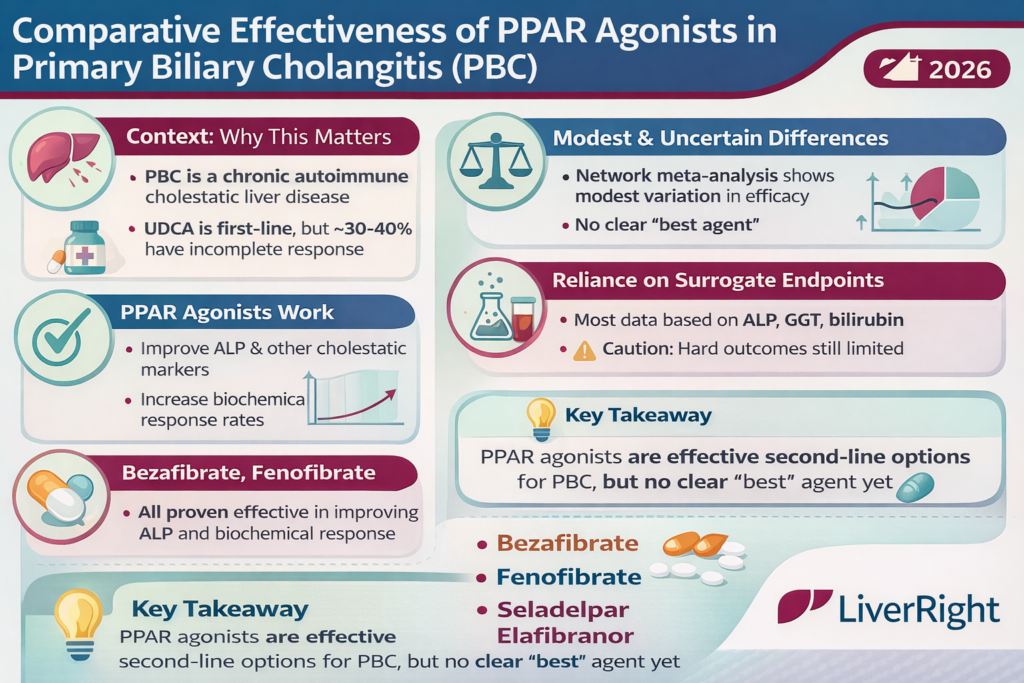
1) Context: why this matters
- Primary biliary cholangitis (PBC) is a chronic autoimmune cholestatic liver disease.
- Ursodeoxycholic acid (UDCA) is first-line, but ~30–40% of patients have incomplete response.
- This has created strong interest in PPAR agonists as second-line therapies.
2) What the article is about
- This is a commentary/editorial, not a primary trial.
- It discusses a comparative effectiveness (network meta-analysis) of different PPAR agonists (e.g., bezafibrate, fenofibrate, elafibranor, seladelpar).
- Focus: How do these drugs compare—not just vs placebo, but against each other?
3) Key takeaways
✅ PPAR agonists clearly work (class effect)
- Across studies, PPAR agonists:
- Improve alkaline phosphatase (ALP) and other cholestatic markers
- Increase biochemical response rates
- This supports their role as effective second-line therapy in PBC.
⚖️ Differences between agents are modest and uncertain
- Comparative analyses suggest some variation in efficacy between drugs, but:
- Differences are not dramatic
- Evidence is indirect (network meta-analysis) rather than head-to-head trials
- Bottom line: no clear “best” PPAR agonist yet
🧪 Surrogate endpoints dominate
- Most data rely on biochemical markers (ALP, GGT, bilirubin)
- These are important—but:
- Hard clinical outcomes (transplant-free survival, mortality) remain limited
- The article emphasizes caution in overinterpreting surrogate-driven rankings
💊 Real-world practicality matters
- Older drugs (e.g., bezafibrate) have:
- Longer real-world experience
- Lower cost
- Newer agents (e.g., seladelpar, elafibranor) have:
- Strong trial data
- Regulatory momentum
- The commentary highlights a tension between innovation vs practicality
⚠️ Evidence gaps
- Lack of:
- Head-to-head RCTs
- Long-term outcomes data
- Heterogeneity across trials (populations, endpoints, designs) limits firm conclusions
4) The Core Insight
- The title reflects the main conclusion:
- Comparative effectiveness studies often show small differences and uncertainty
- That’s expected (“par for the course”) in evolving therapeutic classes
- Clinicians should:
- Avoid overinterpreting rankings
- Focus on patient-specific factors + availability + safety
🧾 Bottom line
- PPAR agonists are a major advance in PBC treatment.
- But:
- They likely represent a class effect
- No single agent clearly dominates yet
- Clinical decision-making should remain pragmatic, not purely data-driven by indirect comparisons.