
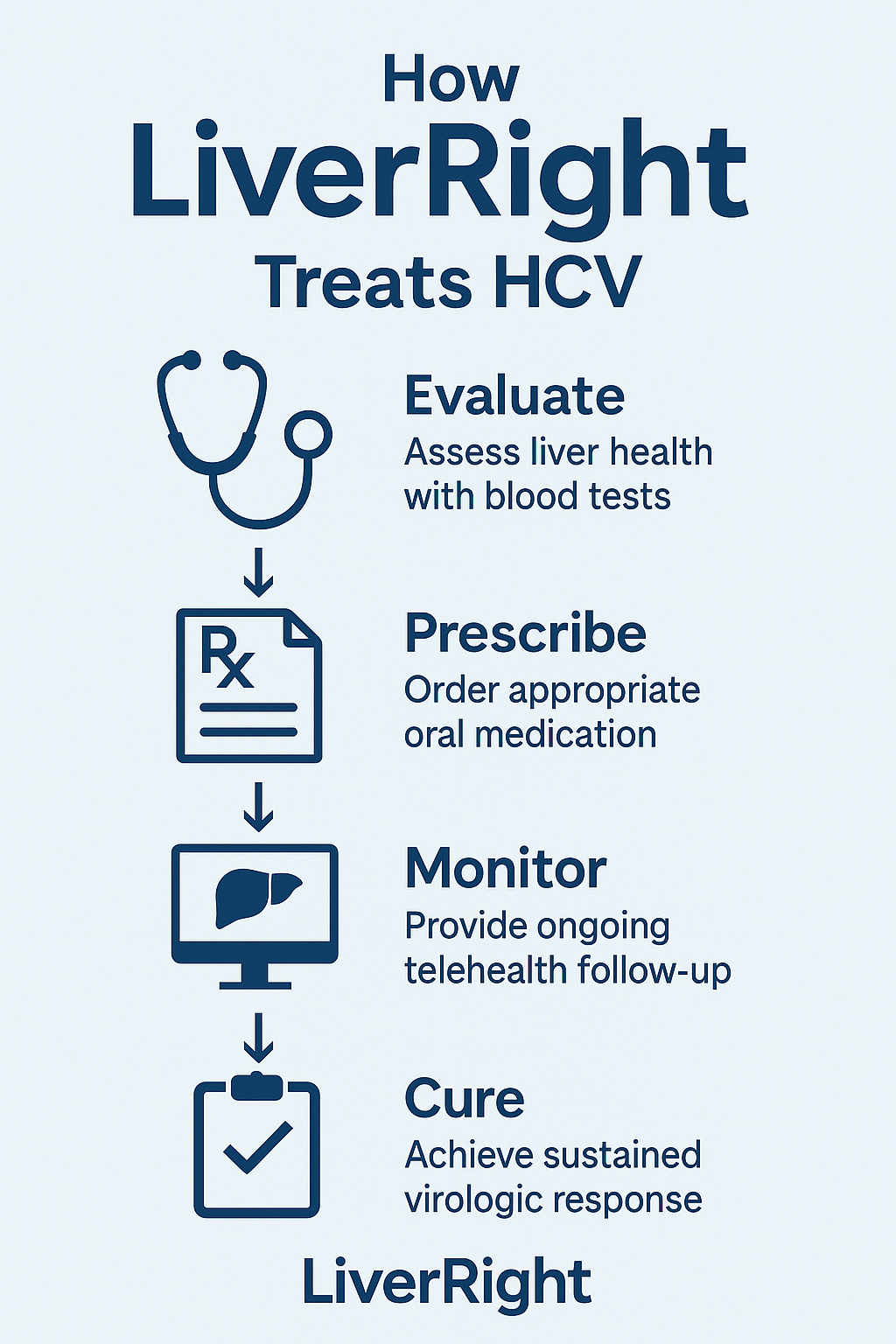
LiverRight triages/diagnoses/treats HCV (and HBV).
Here’s a summary of the highly relevant, recent article titled “Hepatitis C Cure Can Be Assessed 4 Weeks After Treatment” (by Liz Highleyman, 11/11/2025) from HEP Magazine.
Important to know: The medication referenced below, Vosevi (from Gilead), is a salvage regimen for patients who failed a DAA regimen (including Epclusa, Harvoni, Mavyret, etc.).
DAA stands for direct-acting antiviral. These are oral medications that target specific viral proteins to inhibit HCV replication, and they are a highly effective and well-tolerated cure for the infection.
Key points
- Traditionally, cure of hepatitis C (i.e., sustained virological response, or SVR) was assessed at 12 weeks (SVR12) after finishing treatment with modern direct‐acting antivirals (DAAs).
- New data presented at the American Association for the Study of Liver Diseases (AASLD) meeting suggest that measuring HCV RNA at 4 weeks post‐treatment (SVR4) is highly predictive of cure.
- In one pooled analysis of four randomized trials (using the DAA regimen Vosevi = sofosbuvir/velpatasvir/voxilaprevir) involving ~1,009 participants:
- 1,001 achieved both SVR4 and SVR12.
- Eight people achieved SVR4 but did not achieve SVR12.
- Of 23 who did not achieve SVR4, none went on to be cured at 12 weeks.
- Calculated performance: SVR4 had 100% sensitivity, 74.2% specificity, 99.2% positive predictive value, and 100% negative predictive value for SVR12.
- The authors conclude that achieving SVR4 is highly predictive of cure, especially in people likely to be lost to follow-up—so earlier confirmation of cure may be useful.
- Some caveats: greater risk of failure was seen in patients with genotype 1, those with prior DAA therapy, or those on the shorter 8-week Vosevi regimen.
Implications for our work at LiverRight
- The possibility of using SVR4 instead of waiting for SVR12 means we shorten the window to verify cure for patients in our virtual clinic, which may improve retention and reduce follow-up burden.
- For patients at risk of being lost (e.g., remote, limited access, complex comorbidities), confirming cure by 4 weeks may help streamline care.
- We check whether this applies to all populations we treat (e.g., those with cirrhosis, previous DAA failure, different genotypes) because the trial data has limitations.
- By integrating early viral load testing at 4 weeks after therapy completion, it opens up the possibility of planning for early retreatment, or follow-up in the small subset who do not reach SVR4.
Limitations
- The study cohort was from clinical trials of a specific DAA regimen (Vosevi) and may not include all patient sub-types (e.g., decompensated cirrhosis, major comorbidities).
- The specificity was ~74%, meaning that ~26% of those who didn’t reach SVR4 might still be cured by SVR12 (though in this specific dataset none did). So one must be cautious about using SVR4 to rule out cure in all cases.
- This is early evidence; guidelines may not yet universally adopt SVR4 as standard of care for all patient populations.
- The article emphasizes usefulness especially for those at risk of loss to follow-up — but it’s key to contemplate generalization to an entire patient base.