
Here we summarize “Association between metabolic dysfunction-associated steatotic liver disease and obstructive sleep apnea: a nationwide retrospective cohort study” from Scientific Reports (Nature Portfolio), March 2026.
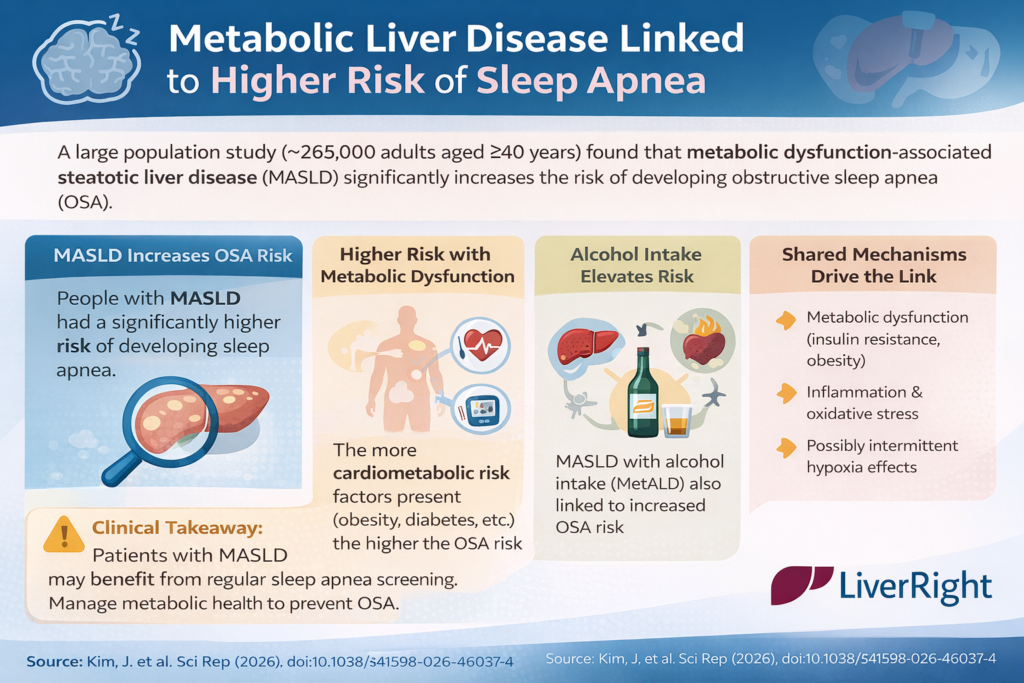
🎯 Objective
The study examined whether metabolic dysfunction-associated steatotic liver disease (MASLD) increases the risk of developing obstructive sleep apnea (OSA) at a population level.
📊 Methods
- Large nationwide cohort of ~265,000 Korean adults ≥40 years
- Participants grouped based on:
- Presence of fatty liver (via fatty liver index)
- Cardiometabolic risk factors (e.g., obesity, diabetes)
- Alcohol intake
- Followed over time to assess new onset (incident) OSA
🔑 Key findings
- MASLD is associated with higher risk of OSA
- Individuals with MASLD had a significantly increased risk of developing OSA compared to those without liver disease.
- Risk increases with metabolic dysfunction severity
- The more cardiometabolic risk factors present, the higher the OSA risk.
- Alcohol-related phenotypes matter
- People with MASLD plus alcohol intake (MetALD spectrum) also showed elevated OSA risk, suggesting combined metabolic + alcohol effects.
- Shared mechanisms likely drive the link
- MASLD and OSA share:
- Metabolic dysfunction (insulin resistance, obesity)
- Inflammation
- Possibly intermittent hypoxia effects
- These overlapping pathways likely explain the association.
- MASLD and OSA share:
🧩 Interpretation
- The relationship between MASLD and OSA is not just coincidental—it likely reflects shared pathophysiology.
- MASLD may be a clinical marker to identify patients at higher OSA risk (and vice versa).
🏥 Clinical implications
- Patients with MASLD should potentially be:
- Screened for sleep apnea
- Managing metabolic health (weight, diabetes, etc.) could help reduce risk of both conditions.
- Supports a multisystem approach to cardiometabolic disease.
⚠️ Limitations
- Observational (cannot prove causality)
- Based on a Korean population → generalizability may vary
- Uses surrogate markers (e.g., fatty liver index) rather than imaging/biopsy
🧠 Bottom line
This large cohort study shows that MASLD significantly increases the risk of developing obstructive sleep apnea, reinforcing that liver disease is part of a broader systemic metabolic disorder rather than an isolated condition.