
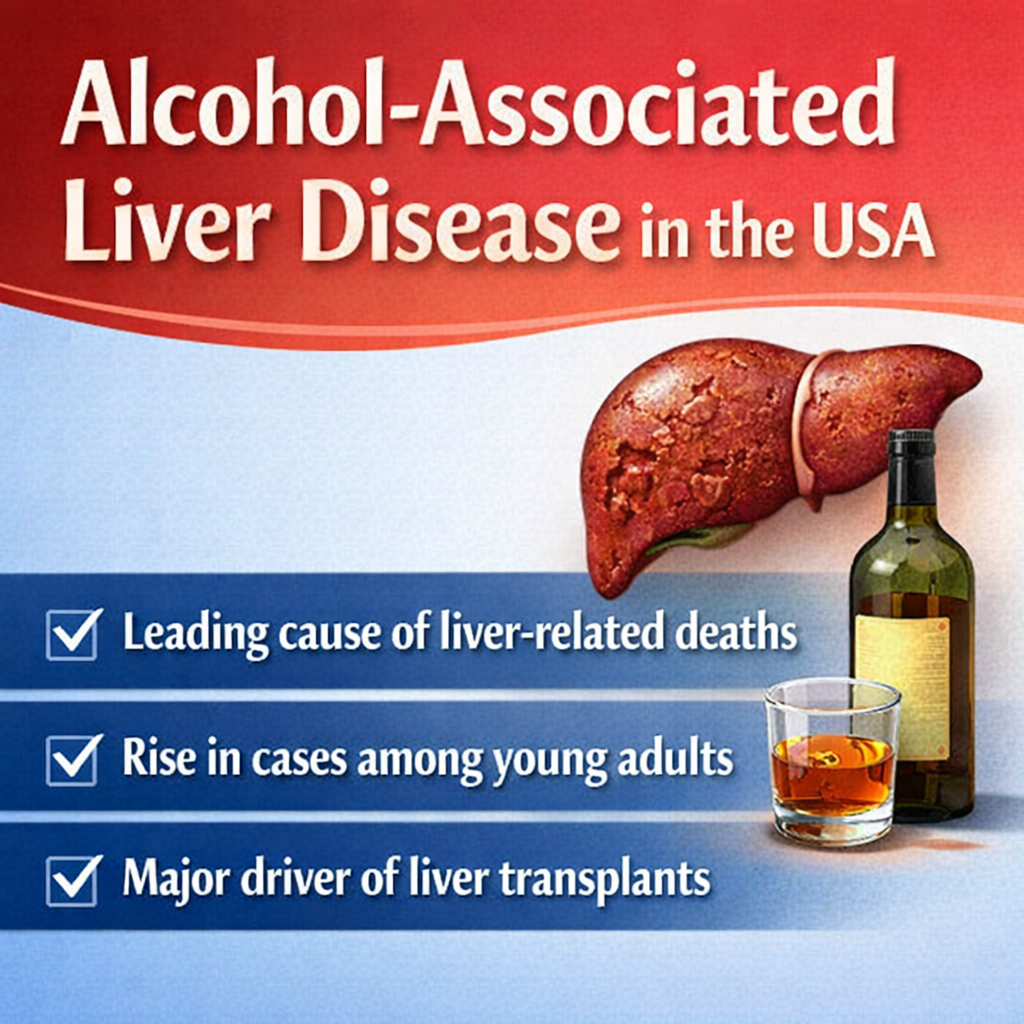
Her’s asummary of the article published online February 25, 2026 in Gastroenterology —
“New Model Performs Well for Detecting Alcohol-Associated Liver Disease”
- A new predictive model (called the MetALD-ALD Prediction Index, or MAPI) was developed to help identify people with alcohol-associated liver disease (ALD) and metabolic dysfunction–associated ALD (MetALD) using routine clinical data.
- The model was created by researchers at UC San Diego and evaluated using a derivation cohort of 503 adults with overweight/obesity and steatotic liver disease. Participants underwent MRI-based liver assessment and phosphatidylethanol (PEth) testing to measure alcohol exposure.
- The final algorithm uses five common clinical variables:
- Sex
- Mean corpuscular volume (MCV)
- Gamma-glutamyltransferase (GGT)
- HDL cholesterol
- Hemoglobin A1c
- Performance:
- AUROC 0.76 in the derivation cohort
- AUROC 0.75 in the validation cohort
These results indicate good predictive accuracy and better performance than commonly used indirect alcohol biomarkers.
- Key advantage:
Because the inputs are standard laboratory tests already used in routine care, the model could be implemented easily and at low cost in clinical settings without additional testing.
Bottom line:
The study introduces a simple, scalable screening model using routine labs to detect alcohol-associated liver disease and MetALD in broader populations, potentially improving early identification and enabling earlier clinical intervention.