
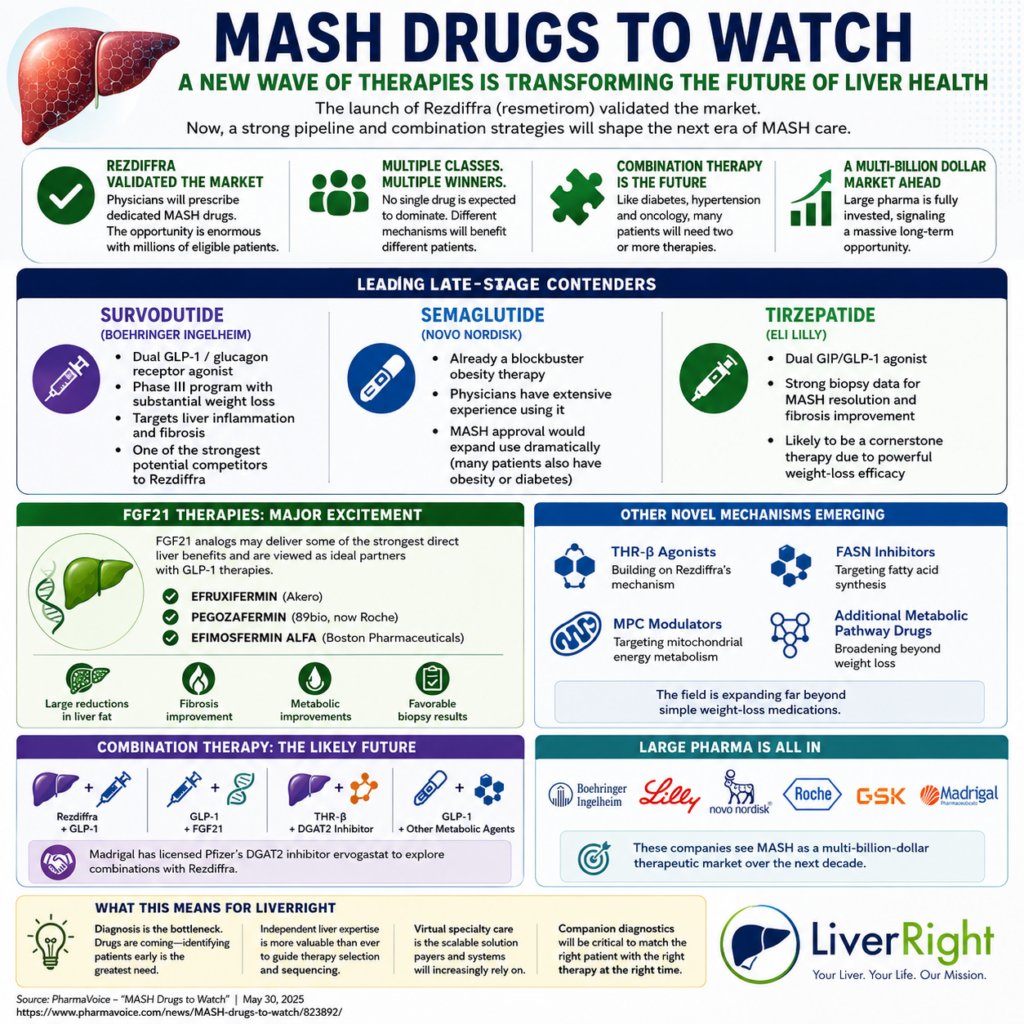
The PharmaVoice article titled “3 late-stage MASH drugs that could rival Rezdiffra” highlights the next wave of MASH therapies expected to compete with Madrigal’s Rezdiffra (resmetirom), emphasizing that the future of MASH treatment will likely involve multiple drug classes and combination therapy, rather than a single dominant medication.
Key Takeaways
1. Rezdiffra has validated the market
- Rezdiffra’s commercial launch demonstrated that physicians will prescribe a dedicated MASH drug.
- The market opportunity is enormous, with millions of patients potentially eligible for therapy.
- The next challenge is finding drugs that improve efficacy, treat more advanced disease, or work well in combination.
2. The leading late-stage challengers
Survodutide (Boehringer Ingelheim)
- Dual GLP-1/glucagon receptor agonist
- One of the most closely watched Phase III programs
- Produces substantial weight loss while also targeting liver inflammation and fibrosis
- Considered among the strongest potential competitors to Rezdiffra.
Semaglutide (Novo Nordisk)
- Already a blockbuster obesity drug
- FDA approval in obesity provides physicians with extensive experience
- MASH indication would dramatically expand its use because many MASH patients also have obesity or diabetes.
Tirzepatide (Eli Lilly)
- Dual GIP/GLP-1 agonist
- Strong biopsy data showing MASH resolution and fibrosis improvement
- Viewed as another likely cornerstone therapy because of its weight-loss efficacy.
3. FGF21 drugs are generating major excitement
Several FGF21 analogs may provide some of the strongest direct liver benefits.
Leading programs include:
- Efruxifermin (Akero)
- Pegozafermin (89bio, now Roche)
- Efimosfermin alfa (Boston Pharmaceuticals)
These agents have shown:
- large reductions in liver fat
- fibrosis improvement
- metabolic improvements
- favorable biopsy results
Many hepatologists believe FGF21 therapies could become key partners with GLP-1 drugs.
4. Additional novel mechanisms
Other approaches include:
- THR-β agonists (building on Rezdiffra)
- Fatty acid synthase (FASN) inhibitors
- Mitochondrial pyruvate carrier (MPC) modulators
- Additional metabolic pathway drugs
The field is broadening beyond simple weight-loss medications.
5. Combination therapy is the likely future
The article suggests MASH may eventually resemble:
- diabetes
- hypertension
- oncology
where many patients receive two or more therapies simultaneously.
Potential combinations include:
- Rezdiffra + GLP-1
- GLP-1 + FGF21
- THR-β + DGAT2 inhibitor
- GLP-1 + other metabolic agents
Madrigal has already licensed Pfizer’s DGAT2 inhibitor ervogastat specifically to explore combinations with Rezdiffra.
6. Large pharma is fully committed
Major companies now investing heavily include:
- Boehringer Ingelheim
- Eli Lilly
- Novo Nordisk
- Roche
- GSK
- Madrigal
This reflects confidence that MASH could become a multi-billion-dollar therapeutic market over the next decade.