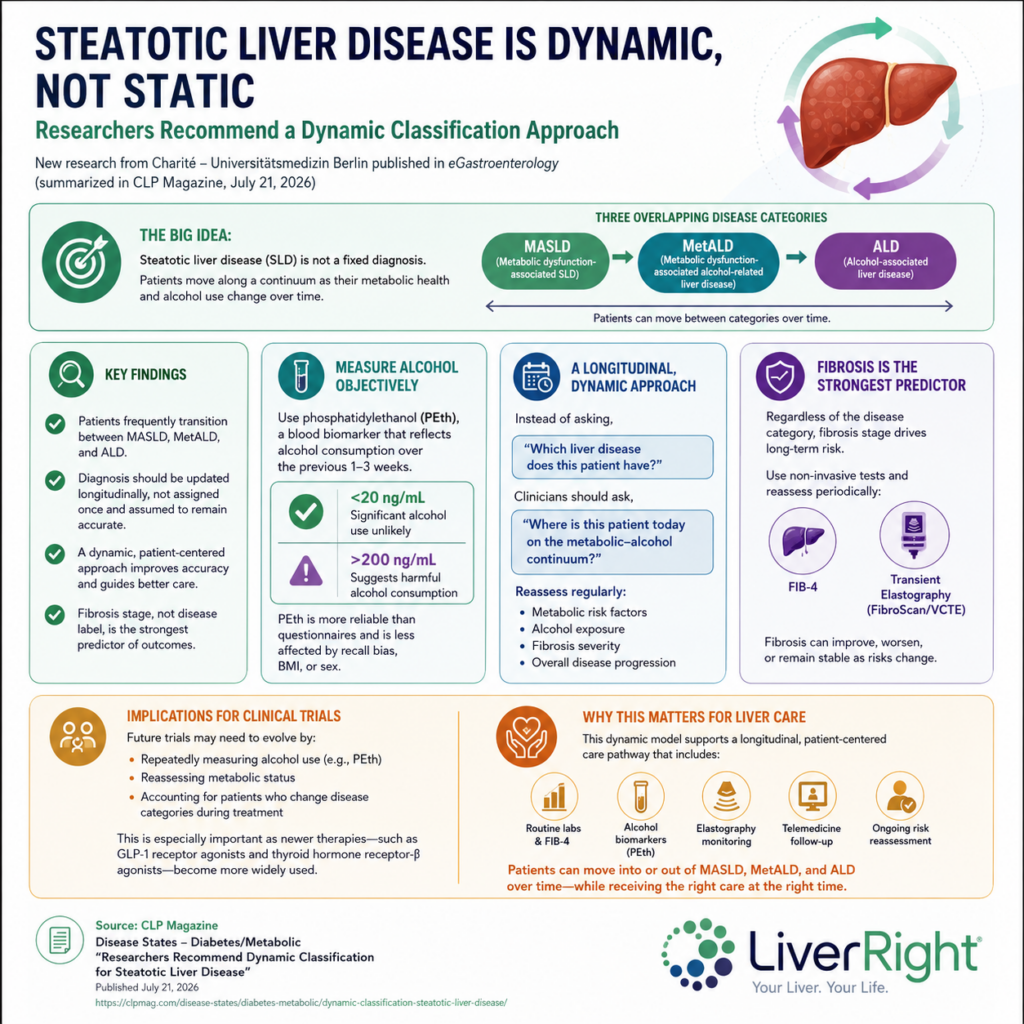
Summary: “Researchers Recommend Dynamic Classification for Steatotic Liver Disease“
Published: July 21, 2026 (CLP Magazine)
Based on research from: Charité – Universitätsmedizin Berlin, published in eGastroenterology
The big idea
The researchers argue that steatotic liver disease (SLD) should no longer be viewed as a set of fixed diagnoses, but instead as a dynamic disease continuum. Patients often move between:
- MASLD (Metabolic dysfunction-associated steatotic liver disease)
- MetALD (Metabolic dysfunction-associated alcohol-related liver disease)
- ALD (Alcohol-associated liver disease)
These changes occur over time as a person’s metabolic health and alcohol consumption change.
Key findings
- Patients frequently transition between MASLD, MetALD, and ALD rather than remaining in one category permanently.
- Diagnosis should therefore be updated longitudinally, not assigned once and assumed to remain accurate.
- Alcohol intake should be measured objectively whenever possible using phosphatidylethanol (PEth), a blood biomarker that reflects alcohol consumption over the previous 1–3 weeks.
- PEth is considered more reliable than patient questionnaires because it is less affected by recall bias, BMI, or sex.
- <20 ng/mL: significant alcohol use unlikely
- >200 ng/mL: suggests harmful alcohol consumption
Clinical implications
Rather than asking:
“Which liver disease does this patient have?”
Clinicians should ask:
“Where is this patient today on the metabolic–alcohol continuum?”
The authors recommend repeatedly reassessing:
- metabolic risk factors
- alcohol exposure
- fibrosis severity
- overall disease progression
throughout follow-up.
Fibrosis remains the most important predictor
Regardless of the disease label, the strongest predictor of long-term outcomes is liver fibrosis.
The paper recommends continued use of non-invasive fibrosis assessment such as:
- FIB-4
- Transient elastography (FibroScan/VCTE)
with periodic reassessment as patients’ risk factors evolve.
Implications for clinical trials
The authors note that clinical trials may also need to evolve.
Rather than enrolling patients based on a single diagnosis at baseline, future trials may need to:
- repeatedly measure alcohol use,
- reassess metabolic status,
- and account for patients changing disease categories during treatment.
This is particularly important as newer therapies—including GLP-1 receptor agonists and thyroid hormone receptor-β agonists—become more widely used.
LiverRight Effect
This paper strongly aligns with our virtual longitudinal care model.
Instead of a one-time diagnosis, patients should be continually monitored using:
- routine laboratory data,
- FIB-4,
- alcohol biomarkers such as PEth,
- elastography,
- and periodic reassessment through telemedicine.
For organizations like LiverRight, this supports an ongoing care pathway in which patients can move into or out of MASLD, MetALD, and ALD classifications over time while receiving appropriate surveillance, lifestyle support, medication management, and fibrosis monitoring.