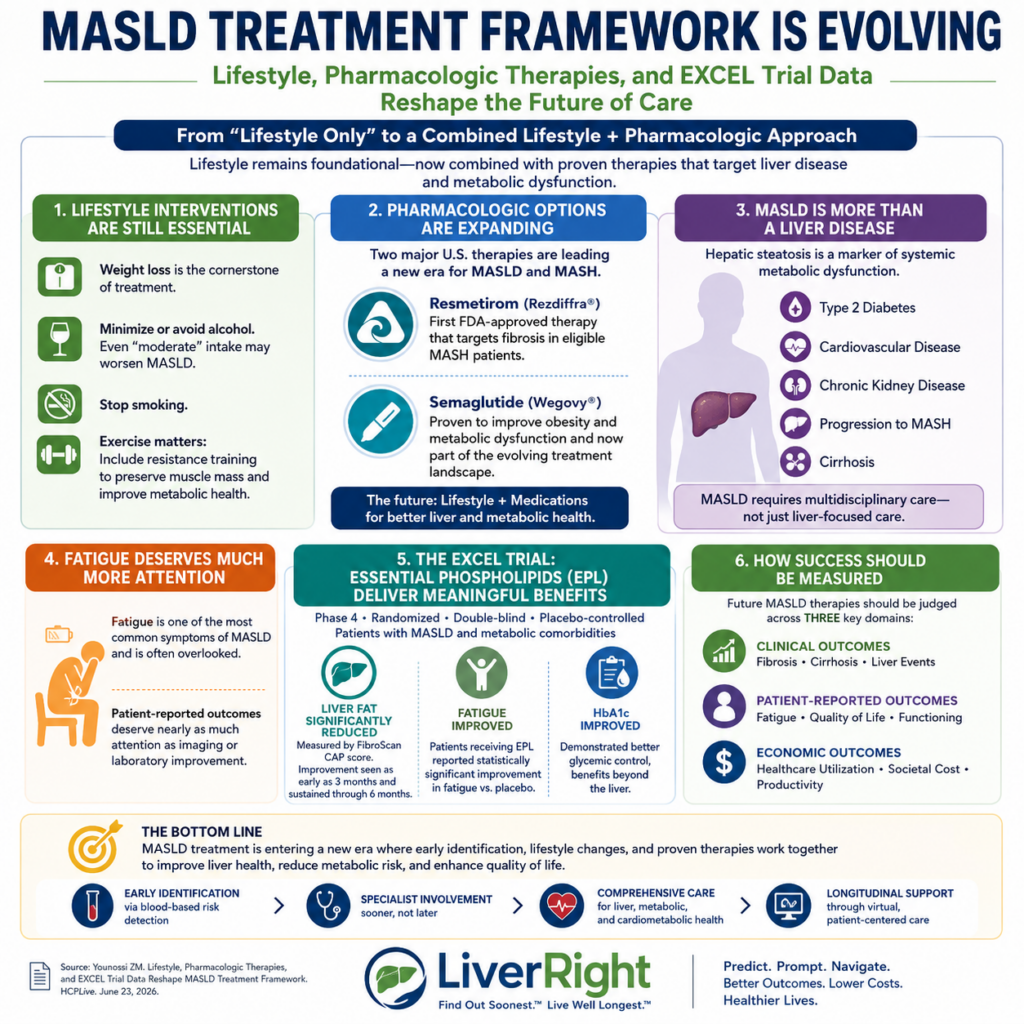
Here are the key takeaways from the HCPLive article, “Lifestyle, Pharmacologic Therapies, and EXCEL Trial Data Reshape MASLD Treatment Framework,” by Dr. Zobair Younossi (published June 23, 2026).
1. MASLD treatment is entering a new era
The article argues that care is shifting from a “lifestyle only” paradigm to a combined lifestyle + pharmacologic approach.
Lifestyle changes remain foundational, but clinicians now have medications that can directly target liver disease and metabolic dysfunction.
2. Lifestyle interventions are still essential
The article emphasizes:
- Weight loss remains the cornerstone of treatment.
- Alcohol should be minimized or avoided, even “moderate” intake may worsen MASLD.
- Smoking cessation is encouraged.
- Exercise should include resistance training, not just aerobic activity, to preserve muscle mass while improving metabolic health.
3. Pharmacologic options are expanding
The article highlights two major U.S. therapies:
- Resmetirom (Rezdiffra) – the first FDA-approved therapy targeting fibrosis in eligible MASH patients.
- Semaglutide (Wegovy) – recognized for improving obesity and metabolic dysfunction and now part of the evolving treatment landscape.
The overall message is that future management will increasingly combine medications with lifestyle modification.
4. MASLD is much more than a liver disease
The article reinforces that hepatic steatosis is a marker of systemic metabolic dysfunction.
Patients are simultaneously at higher risk for:
- Type 2 diabetes
- Cardiovascular disease
- Chronic kidney disease
- Progression to MASH
- Cirrhosis
This supports multidisciplinary care rather than treating the liver in isolation.
5. Fatigue deserves much more attention
One important point is that fatigue is one of the most common symptoms of MASLD but is often overlooked by clinicians.
The article suggests patient-reported outcomes deserve nearly as much attention as imaging or laboratory improvement.
6. The EXCEL Trial
The article’s major focus is the new Phase 4 EXCEL trial evaluating essential phospholipids (EPL) added to standard care.
Study design:
- Randomized
- Double-blind
- Placebo-controlled
- Patients had MASLD plus metabolic comorbidities
Main findings:
Primary endpoint achieved
- Significant reduction in liver fat measured by FibroScan CAP score.
- Improvement seen as early as 3 months.
- Benefit persisted through 6 months.
Fatigue improved
Patients receiving EPL reported statistically significant improvement in fatigue versus placebo.
HbA1c improved
The trial also demonstrated improved glycemic control, suggesting benefits beyond the liver itself.
7. How success should be measured
Dr. Younossi argues that future MASLD therapies should be judged across three domains:
- Clinical outcomes
- fibrosis
- cirrhosis
- liver events
- Patient-reported outcomes
- fatigue
- quality of life
- functioning
- Economic outcomes
- healthcare utilization
- societal cost
- productivity
This broader framework reflects the real-world burden of MASLD.