
From 02/23/2026, an article that highlights the overlap between kidney stones and MASLD: “Association between metabolic dysfunction-associated steatotic liver disease and kidney stone risk in individuals with metabolic dysfunction: evidence from cross-sectional and cohort analyses“.
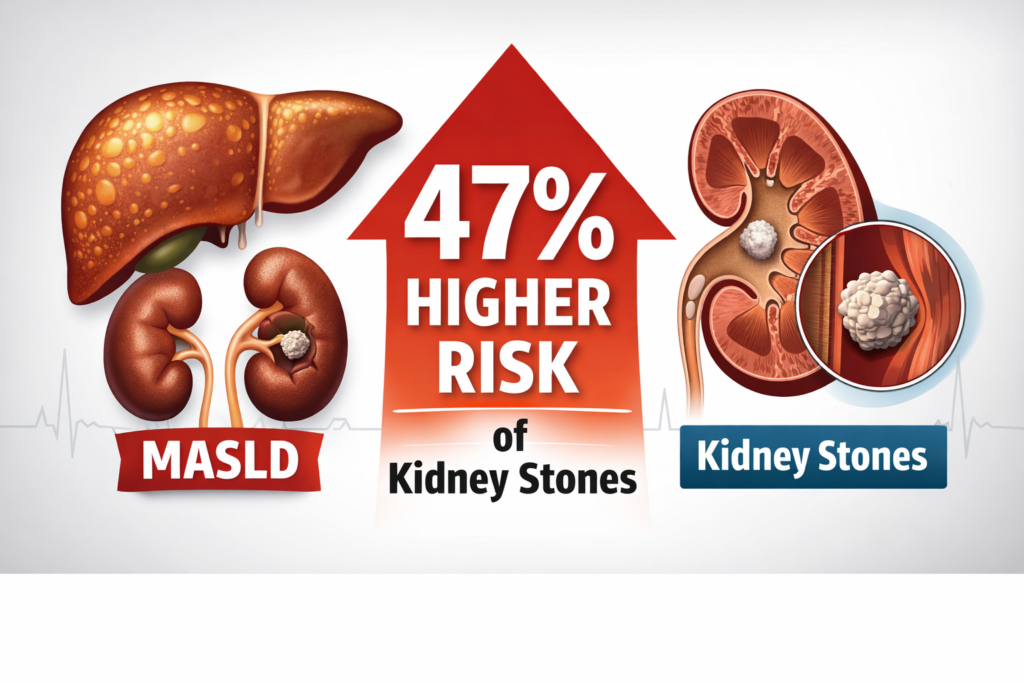
Summary–
1. Study design
The research used two complementary analyses:
- Cross-sectional study: ~1,875 participants
- Prospective cohort: ~1,903 participants followed for ~35 months
Researchers used multivariable regression models to adjust for metabolic risk factors.
Main Findings
MASLD increases kidney stone risk
- MASLD was independently associated with kidney stones
- Adjusted odds ratio: 1.47 (≈47% higher odds) in the cross-sectional analysis.
Incident kidney stones occurred during follow-up
- 94 new kidney stone cases
- Incidence: 17.6 per 1,000 person-years.
Potential biological mediators
The study suggests that the relationship may be partially mediated by:
- Insulin resistance (METS-IR)
- Inflammation (white blood cell count)
- Kidney function (eGFR)
These pathways suggest MASLD contributes to systemic metabolic and inflammatory changes that promote stone formation.
How strong is the overall evidence?
Multiple studies support the link.
Large hospitalization analysis
- MASLD patients had >3× higher odds of kidney stones compared with people without liver fat.
Meta-analysis (~248k adults)
- MASLD associated with 87% higher prevalence of urolithiasis.
NHANES population study
- MASLD associated with ~1.35× increased risk of kidney stones.
Why MASLD may cause kidney stones
Researchers propose several mechanisms:
1. Insulin resistance
- Promotes acidic urine
- Increases uric acid stones
2. Chronic inflammation & oxidative stress
- Alters renal tubular function
3. Shared metabolic drivers
- Obesity
- Diabetes
- Dyslipidemia
- Metabolic syndrome
Clinical implications
The study suggests clinicians should consider:
- Kidney stone risk screening in MASLD patients
- Metabolic risk management (weight, diabetes, insulin resistance)
- A systems-level view of MASLD as a multi-organ metabolic disease rather than a liver-only condition.
✅ Bottom line:
MASLD appears to be independently associated with higher kidney stone risk, likely through metabolic and inflammatory pathways shared across liver and kidney disease.
This kind of evidence reinforces the concept that MASLD is a systemic metabolic disease with multi-organ consequences, not just a liver condition—something that supports earlier identification and risk-stratification models like those used in population screening at LiverRight.