
The March 2026 journal article titled “Increasing Transplant Access for Low MELD Patients in the United States: Do We Still Need to Increase Adult Living Donor Liver Transplantation?” is thought provoking.
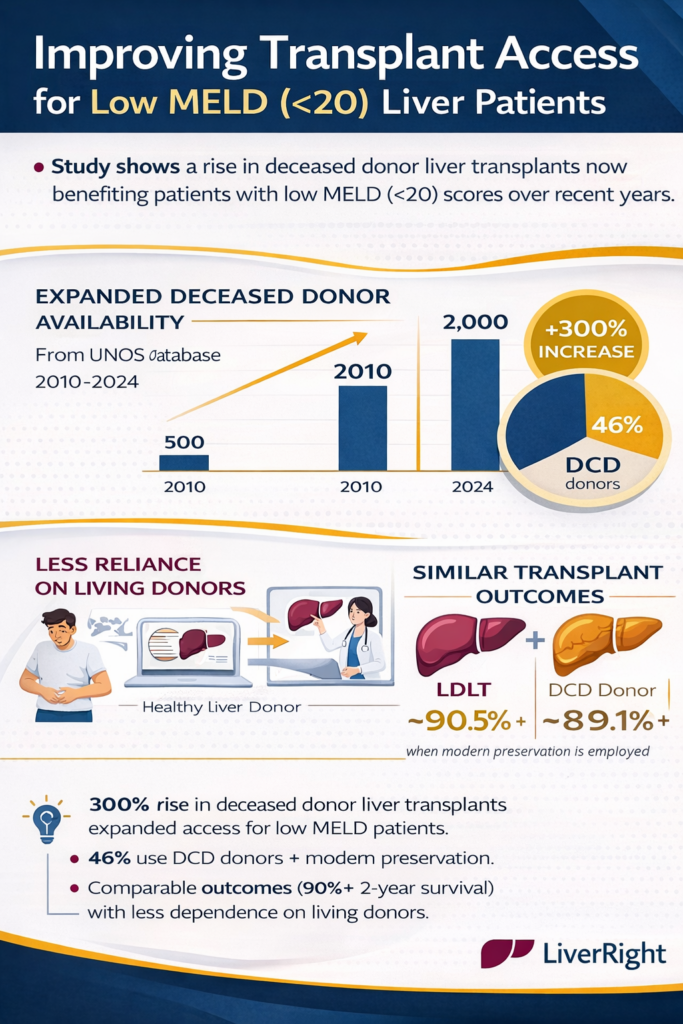
Study Overview
This study examines whether living donor liver transplantation (LDLT) is still necessary for patients with low MELD scores (<20) in the U.S., given increasing availability of deceased donor liver transplants (DDLT)—especially from donation after circulatory death (DCD) donors.
Key Findings
- DDLT availability has increased significantly for low-MELD patients:
- Transplants rose from 492 (2010) to 2049 (2024).
- Nearly 46% of these were from DCD donors.
- LDLT usage is declining, dropping ~15% from 2023 → 2024.
- Waitlist access improved:
- Higher likelihood of receiving DDLT within 1 year for low-MELD patients.
- Outcomes are comparable:
- 2-year graft survival:
- LDLT: 90.5%
- DCD DDLT (with machine perfusion): 89.1%
- No significant difference.
- 2-year graft survival:
Core Conclusion
- The growing supply and improving outcomes of deceased donor livers (especially DCD + machine perfusion) mean that:
- LDLT may no longer be as necessary for low-MELD patients as it once was.
- Expanding DCD transplantation could reduce reliance on living donors, avoiding risk to healthy individuals.
Why It Matters (Clinical Implication)
- Signals a shift in transplant strategy:
- From relying on living donors → toward optimized deceased donor utilization.
- Supports broader adoption of:
- DCD liver transplantation
- Normothermic machine perfusion (NMP)
- Could influence:
- Transplant center policies
- Patient counseling
- Resource allocation