See this 2026 Journal of Hepatology review titled “Surveillance of patients at risk of liver cancer: Expert opinions.”
It asks an important question: Does routinely screening people at high risk for liver cancer actually help them live longer?
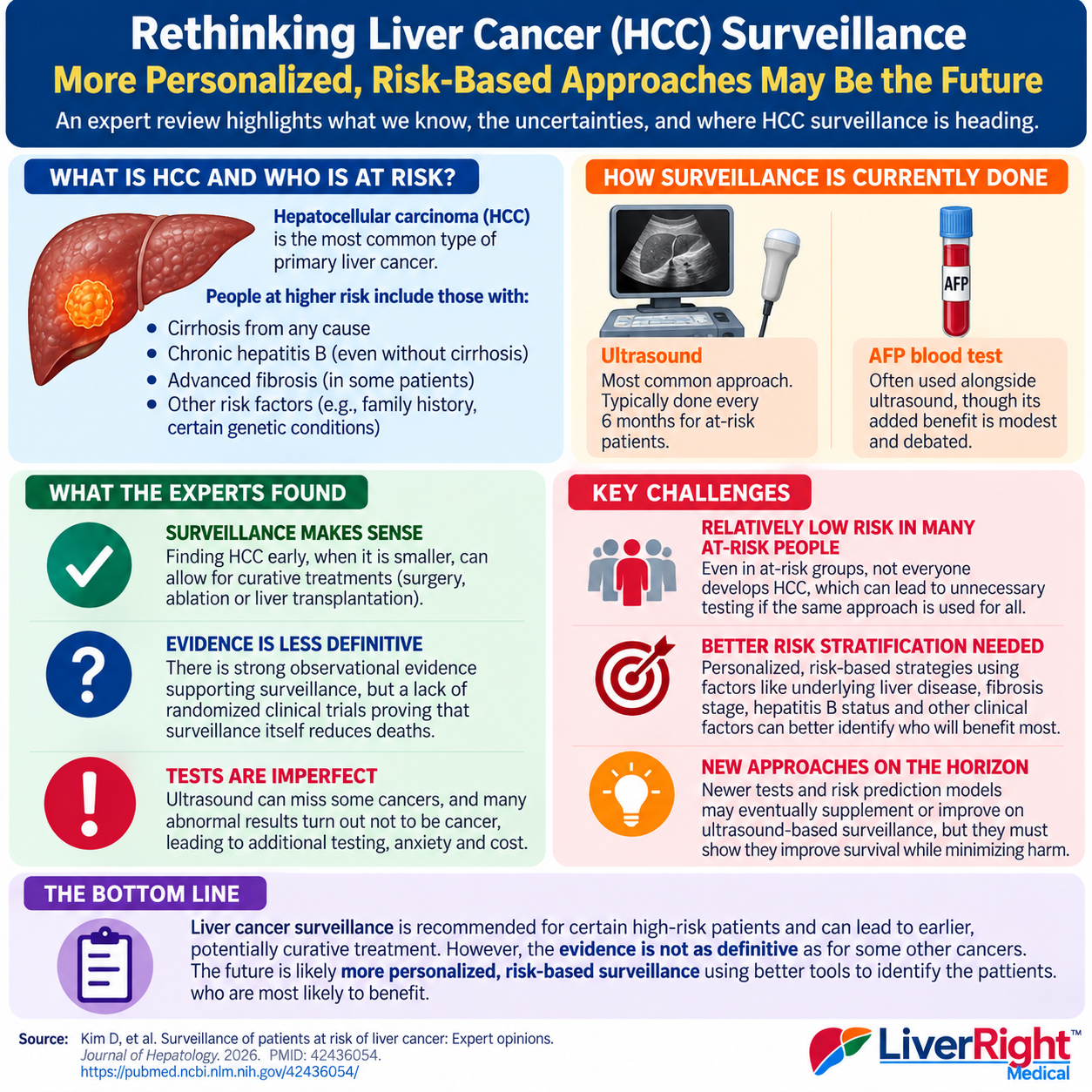
Doctors commonly screen people at increased risk for hepatocellular carcinoma (HCC), the most common primary liver cancer. Surveillance often involves an ultrasound every six months, sometimes combined with an AFP blood test. The idea is straightforward: find liver cancer when it is small and potentially curable rather than after it has become advanced.
The authors point out, however, that the scientific evidence behind liver-cancer surveillance is less definitive than many people realize. There is substantial observational evidence supporting surveillance, but there is a lack of randomized clinical trials proving that surveillance itself reduces deaths. That gap has existed for more than 25 years.
Another challenge is that liver cancer remains relatively uncommon even among many people considered “at risk.” Screening tests are also imperfect. As a result, many abnormal screening results turn out not to be cancer, potentially leading to additional imaging, testing, anxiety and expense. Ultrasound can also miss some cancers.
The authors therefore argue that the future may be more personalized, risk-based surveillance rather than treating every at-risk patient exactly the same. A person’s underlying liver disease, degree of fibrosis or cirrhosis, hepatitis B status and other factors can help estimate the likelihood of developing HCC. Risk-prediction models are already being used in chronic hepatitis B.
Newer approaches may eventually supplement or replace conventional ultrasound. But the authors emphasize that simply having a newer test isn’t enough—the ultimate question is whether a surveillance strategy finds important cancers early enough to improve survival while minimizing unnecessary testing and harm.
The consumer takeaway: Liver-cancer surveillance makes intuitive sense and is recommended for certain high-risk patients, but the evidence isn’t as ironclad as it is for some other cancer-screening programs. The direction of the field is toward identifying who is truly at highest risk and tailoring surveillance accordingly, while developing better screening tools.