Summary: Lean Fatty Liver May Still Carry Meaningful Liver Risk
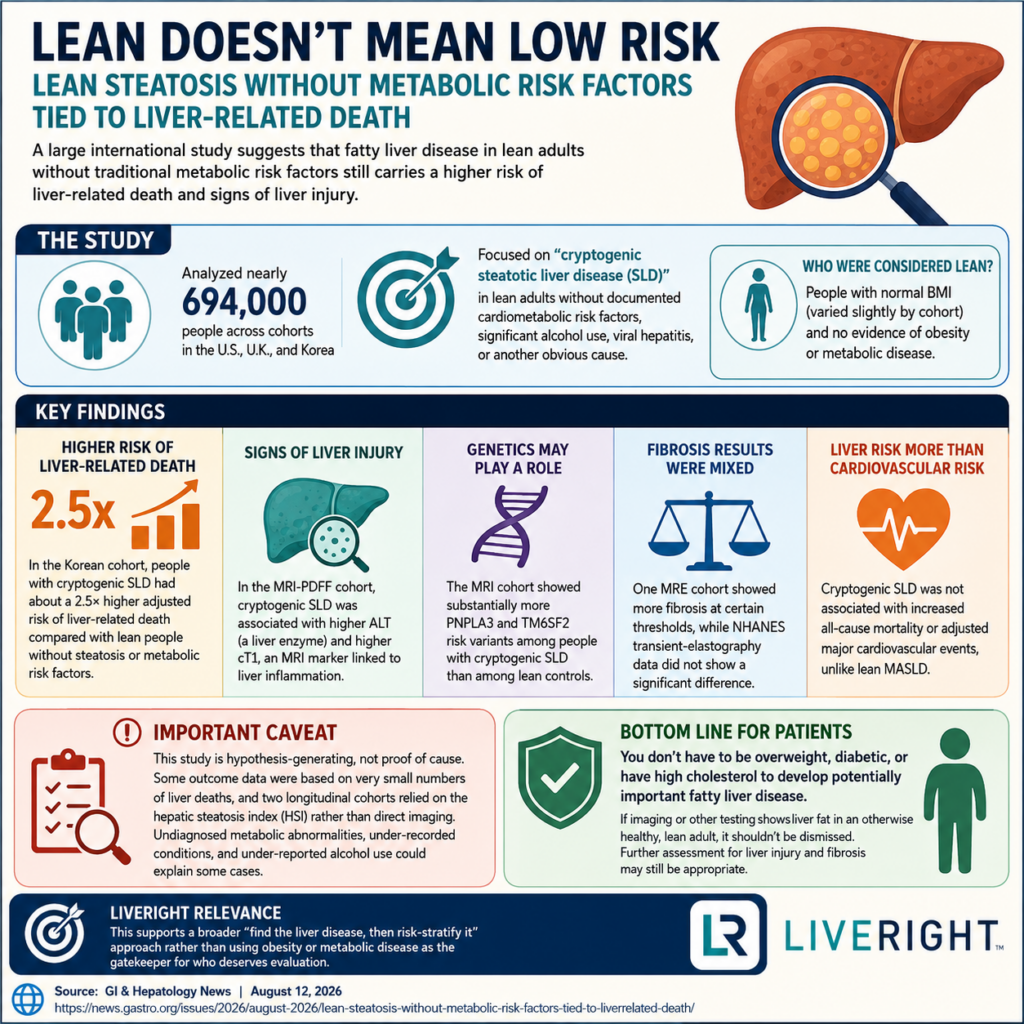
A large multinational study highlighted by GI & Hepatology News (Aug. 12, 2026), titled “Lean steatosis without metabolic risk factors tied to liver-related death,” challenges the idea that fatty liver is mainly a problem for people who are overweight or have obvious metabolic risk factors.
Researchers studied nearly 694,000 people across several cohorts in the U.S., U.K., and Korea. They focused on “cryptogenic steatotic liver disease (SLD)”—fat accumulation in the liver among lean adults without documented cardiometabolic risk factors, significant alcohol use, viral hepatitis, or another obvious cause.
The most important findings:
- Lean doesn’t necessarily mean low liver risk. In the Korean cohort, people with cryptogenic SLD had about a 2.5× higher adjusted risk of liver-related death than lean people without steatosis or metabolic risk factors.
- There were signs of underlying liver injury. In the MRI-PDFF cohort, cryptogenic SLD was associated with higher ALT and higher cT1, an MRI marker associated with liver inflammation.
- Genetics may play a role. The MRI cohort showed substantially more PNPLA3 and TM6SF2 risk variants among people with cryptogenic SLD than among lean controls.
- Fibrosis results were less clear. One MRE cohort showed more fibrosis at certain thresholds, while NHANES transient-elastography data did not show a significant difference.
- Interestingly, the excess risk appeared more liver-specific than cardiovascular. Cryptogenic SLD wasn’t associated with increased all-cause mortality or adjusted major cardiovascular events, unlike lean MASLD.
Important caveat
This is not yet proof that cryptogenic/lean SLD independently causes higher mortality. Some of the outcome data were based on very small numbers of liver deaths, and two longitudinal cohorts relied on the hepatic steatosis index (HSI) rather than direct imaging. The accompanying expert commentary specifically calls the study hypothesis-generating and notes that undiagnosed metabolic abnormalities, under-recorded conditions, and under-reported alcohol consumption could explain some cases.
Bottom line for patients
You don’t have to be overweight, diabetic, or have high cholesterol to develop potentially important fatty liver disease.
If imaging or other testing shows liver fat in an otherwise healthy, lean adult, the finding probably shouldn’t simply be dismissed because the patient lacks the traditional metabolic profile. Further assessment for liver injury and fibrosis may still be appropriate—a point emphasized by the expert commentary accompanying the study.
LiverRight relevance: This supports our “find the liver disease, then risk-stratify it” approach rather than using obesity or metabolic disease as the gatekeeper for who deserves evaluation.