
This article is worth reading, from JAMA Internal Medicine dated March23, 2026: “Health Benefits, Costs, and Cost-Effectiveness of Jail-Based Hepatitis C Elimination Strategies“.
🎯 Objective
The study evaluated whether screening, treating, and supporting hepatitis C (HCV) care in Corrections Centers is effective and cost-efficient—especially for people who inject drugs (PWID), a high-risk group.
🔑 Key Findings
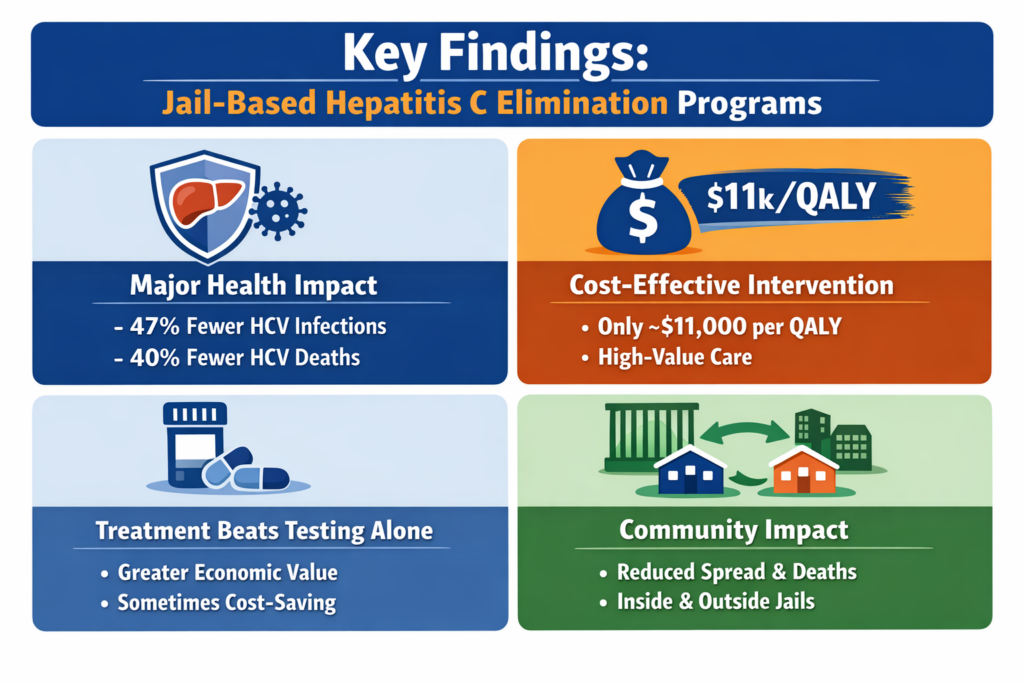
- Large health impact:
Corrections Center-based HCV programs (testing + treatment + post-release support) reduced:- HCV infections by ~47%
- HCV-related deaths by ~40%
- Cost-effective intervention:
- About $11,000 per quality-adjusted life-year (QALY) gained
- Well below typical thresholds ($50k–$150k/QALY), making it high-value care
- Treatment > testing alone:
- Providing treatment during incarceration produced greater economic value and sometimes cost savings compared to testing only
- Benefits extend beyond Corrections Centers:
- Reduced transmission and deaths both inside Corrections Centers and in the broader community
🧩 Why Corrections Center Matter
- High overlap between:
- Injection drug use
- Incarceration (≈25% of PWID incarcerated annually)
- Corrections Center are a high-throughput, local “touchpoint” for reaching underserved patients
- Opportunity to link patients to care after release (navigation services)
⚠️ Challenges Highlighted
- Short Corrections Center stays → incomplete treatment
- Loss to follow-up after release
- Budget misalignment (Corrections Centers bear costs, society gains benefits)
🧠 Bottom Line
Corrections Center-based HCV programs—especially those that include treatment—are one of the most effective and cost-efficient strategies for reducing hepatitis C at a population level.
They represent a high-impact public health intervention that improves outcomes both for incarcerated individuals and the wider community.