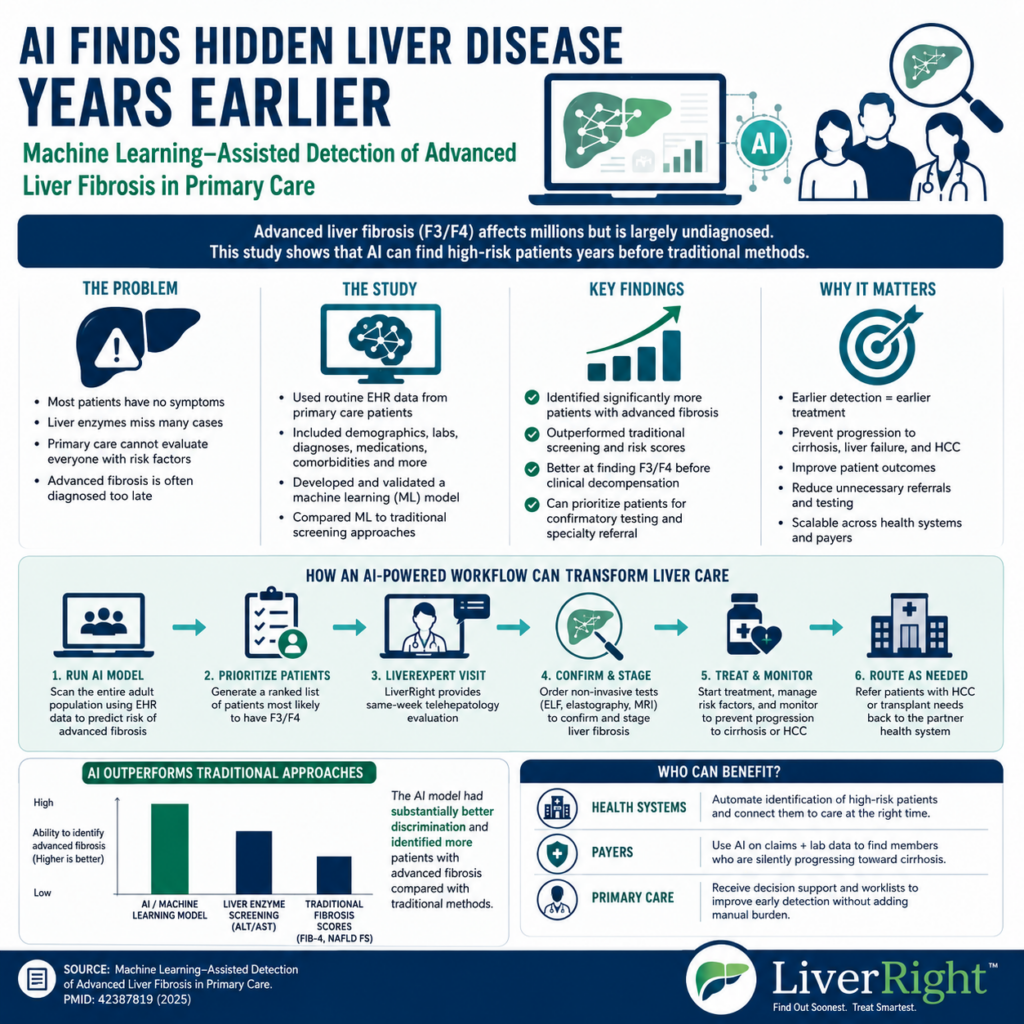
Here’s a summary of the paper titled:
Machine Learning–Assisted Detection of Advanced Liver Fibrosis in Primary Care (2025)
One-sentence summary
The study found that an AI/machine learning approach applied to routine primary care data substantially improved identification of patients with advanced liver fibrosis compared with conventional screening strategies, suggesting a practical way to find patients years earlier.
Why the study matters
Advanced liver fibrosis (F3/F4) is frequently undiagnosed because:
- most patients have no symptoms,
- elevated liver enzymes alone miss many cases,
- primary care clinicians cannot evaluate every patient with obesity, diabetes, or metabolic syndrome.
The authors evaluated whether machine learning could identify high-risk patients using information already present in the electronic health record.
Study design
The investigators:
- Used routinely collected EHR data (demographics, laboratory values, diagnoses, medications, comorbidities, etc.).
- Developed and validated a machine-learning prediction model.
- Compared its performance against traditional approaches such as liver enzyme screening and standard fibrosis risk scores.
Main findings
The ML model:
- Identified substantially more patients with advanced fibrosis.
- Produced better discrimination than traditional rule-based screening.
- Could prioritize patients for non-invasive fibrosis testing (FibroScan, ELF, MRI, hepatology referral).
- Demonstrated potential to improve early diagnosis while reducing unnecessary specialty referrals.
Clinical implications
For health systems:
- Run the algorithm on the entire adult EHR.
- Generate a worklist of patients likely to have F3/F4.
- Refer only those above a chosen threshold for confirmatory testing.
For payers:
- Similar models could be run on claims + lab data to identify members who are silently progressing toward cirrhosis.
For primary care:
- Provides automated decision support instead of relying on physicians to manually calculate FIB-4 or recognize subtle risk patterns.