
At the core of diagnosing — and surveilling longitudinal care — is the FIB-4, from a standard CBC aka Complete Blood Count (bloodwork), from a venipuncture e.g., at Quest or Labcorp.
This is irrespective of fast-rising Transient Liver Elastography, a non-invasive ultrasound-based technique used to assess liver stiffness, which is an indicator of liver fibrosis. It helps in diagnosing and monitoring liver diseases by measuring the elasticity of the liver tissue.
The FIB-4 index is a non-invasive calculation used to assess the risk of liver fibrosis, particularly in patients with non-alcoholic fatty liver disease (NAFLD), which of course is now known as Metabolic Dysfunction-Associated Steatotic Liver Disease (MASLD), or hepatitis C.
It utilizes age, AST (aspartate aminotransferase), ALT (alanine aminotransferase), and platelet count to estimate the extent of liver scarring.
The FIB-4 index is calculated using the following formula:
FIB-4 = (Age (years) x AST (IU/L)) / (Platelet count (10^9/L) x √ALT (IU/L)).
Interpretation:
Low risk: A low FIB-4 score (e.g., less than 1.3 or 1.45 depending on the source and age group) suggests a low likelihood of significant liver fibrosis and may indicate that further investigation or biopsy can be avoided.
Intermediate risk:
.
A score in the intermediate range (e.g., 1.3 to 2.67 or 1.45 to 3.25) may require further evaluation with additional tests like liver elastography or direct fibrosis markers.
High risk: A high FIB-4 score (e.g., greater than 2.67 or 3.25) suggests a higher likelihood of advanced liver fibrosis and may warrant referral to a specialist for further assessment, potentially including a liver biopsy.
Some Important Considerations follow–
Age:
The interpretation of the FIB-4 index should be done with consideration of the patient’s age, as the index’s accuracy can vary in different age groups, particularly in those younger than 35 or older than 65.
Clinical context:
The FIB-4 index is a screening tool and should be interpreted in the context of other clinical information and patient history.
Limitations:
The FIB-4 index is not perfect and has limitations. False positives and false negatives can occur, and it may not be as accurate in all liver diseases or in certain patient populations.
Referral:
In cases of high-risk FIB-4 scores, referral to a specialist — such as our very own LiverRight — for further evaluation is generally recommended.
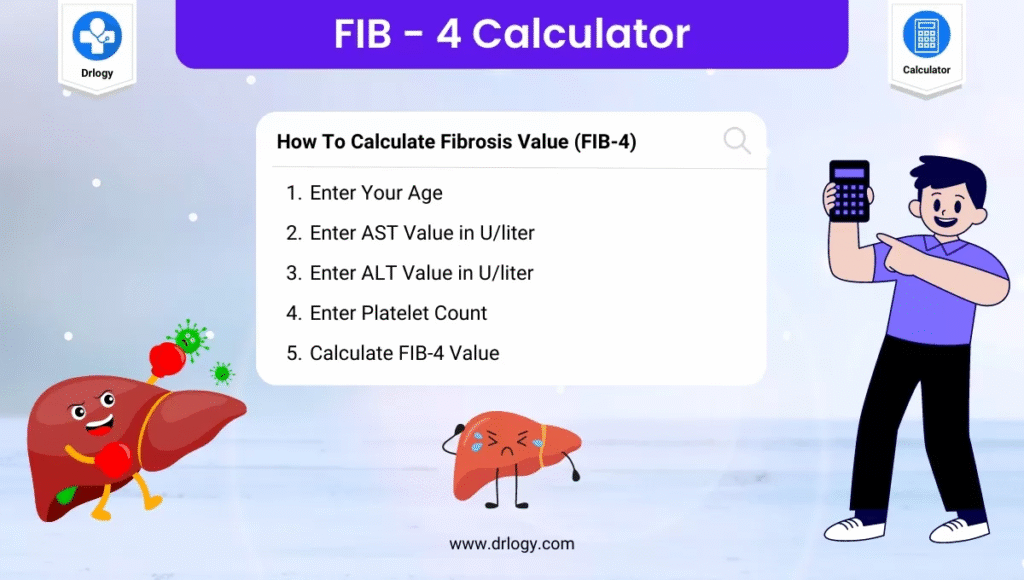
IMAGE SOURCE: DRLOGY.com