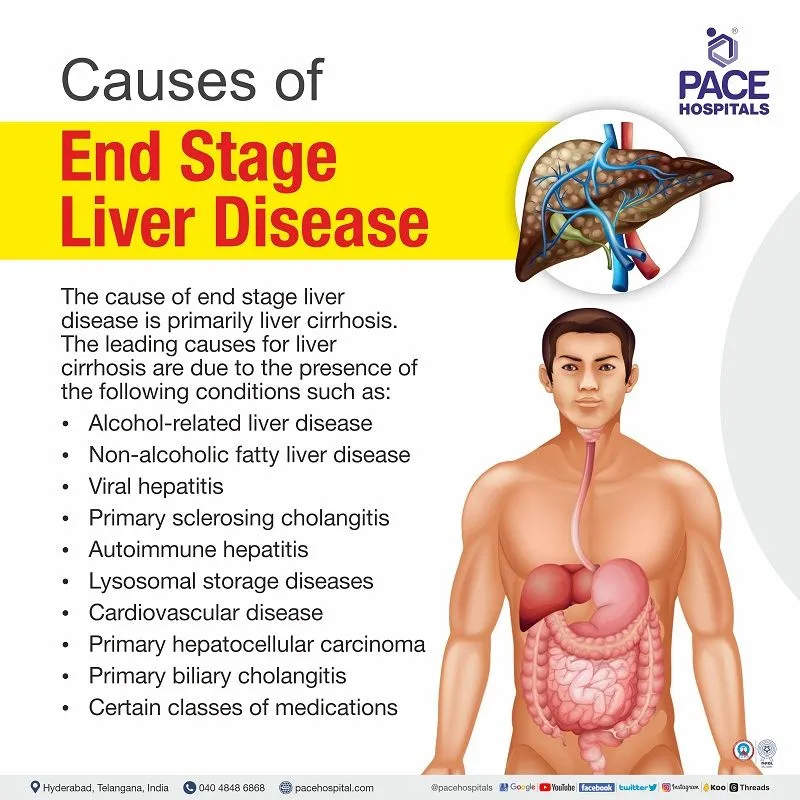
End stage liver disease (ESLD), also known as the final stage liver failure, is an irreversible liver condition that occurs due to acute liver failure or chronic liver diseases resulting in disruption of hepatic parenchyma (liver cells) and the adjacent structures (hepatic blood vessels and the bile ducts). It is a culmination of chronic liver disease that progresses to cirrhosis, decompensation, and chronic liver failure, which might lead to portal hypertension or complications related to hepatic failure.
The end stage liver disease is characterised by the presence of (any) chronic liver failure, decompensated cirrhosis (scar tissue replaces damaged tissue in the liver), and stage 4 hepatitis. Patients with end stage liver disease usually have either decompensated or compensated cirrhosis.
Compensated liver disease: Patients are often asymptomatic or have few symptoms, though the patient has progressed to cirrhosis (the last stage of liver failure). Some patients with compensated liver disease can develop hepatocellular cancer.
Decompensated liver disease: Cirrhotic patients under this category have an acute deterioration in liver function characterized by severe symptoms and complications that increase the risk of mortality.
And from this March of 2025 seminal article entitled “Cirrhosis: A Public Health Crisis as Care Burden Tops Heart Failure and COPD“–
“Average monthly costs overall for patients with cirrhosis reached $3,032—21.7% higher than those associated with HF ($2,492) and 55.0% higher than those for COPD ($1,956).
Monthly expenses were $1,749 per patient-month for those with compensated cirrhosis, with ‘Other’ costs (related to neither inpatient nor outpatient care) accounting for 37% of the total monthly cost.
Decompensated cirrhosis was even more costly, with per-patient monthly expenses rising to $3,969 — 59.3% higher than those for HF and 103.0% higher than those for COPD. Inpatient care accounted for nearly half (48%) of total decompensated cirrhosis patient-month costs, reflecting longer, more medically complex hospitalizations.”
Here’s a superb graphic from PACE Hospitals—