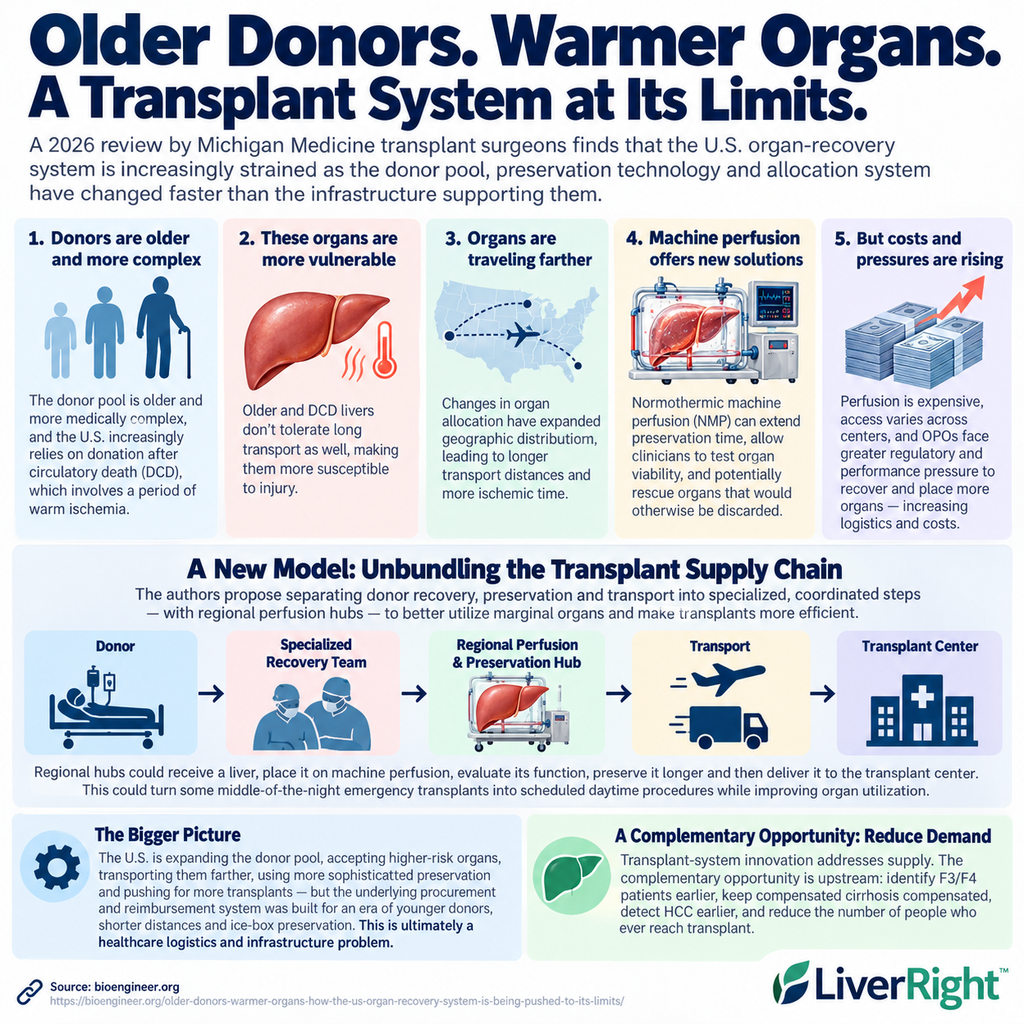
The Bioengineer.com article “Older Donors, Warmer Organs: How the US Organ Recovery System Is Being Pushed to Its Limits” summarizes a 2026 review by Michigan Medicine transplant surgeons Christina Fleischer and Kyle Sheetz arguing that the U.S. organ-recovery system is becoming increasingly expensive and operationally strained because the donor pool, preservation technology, and allocation system have all changed faster than the infrastructure supporting them.
For liver transplantation in particular, the important points are:
- Donors are getting older and more medically complex. Atthe same time, the U.S. is increasingly relying on donation after circulatory death (DCD) rather than traditional donation after brain death. DCD organs experience a period of warm ischemia after circulation stops, making them more vulnerable to injury.
- Older/DCD livers don’t tolerate long transport as well. Meanwhile, changes in organ allocation have expanded geographic distribution, meaning organs often travel farther. That creates a difficult combination: more fragile organs + longer distances + more ischemic time.
- Machine perfusion is becoming a major solution. Instead of simply putting a liver on ice, technologies such as normothermic machine perfusion (NMP) circulate oxygenated blood or fluid through the liver. This can extend preservation time, allow clinicians to test whether an organ is viable, and potentially rescue organs that previously would have been discarded.
- But perfusion is expensive. The machines, disposables and specialized personnel substantially increase organ-acquisition costs. The authors also flag potential equity issues because access to perfusion technology varies among transplant centers and patient populations.
- Allocation reform has created a logistics problem. Moving away from predominantly local organ allocation has increased the number of offers transplant centers must evaluate, transportation distances, coordination requirements and costs.
- OPOs are under pressure to recover more organs. CMS and HRSA have increased performance oversight, while programs such as the Increasing Organ Transplant Access (IOTA) model are intended to increase transplant volume. The result is greater pressure to recover and successfully place organs that historically might have been declined.
The interesting proposed solution
The authors essentially suggest unbundling the transplant supply chain.
Today, OPOs coordinate much of the donor/recovery/preservation/transport process. A future model could separate those functions into specialized businesses or organizations:
Donor → Specialized Recovery Team → Regional Perfusion/Preservation Hub → Transport → Transplant Center
Regional hubs could receive a liver, place it on machine perfusion, evaluate its function, preserve it longer and then deliver it to the transplant center. That could potentially turn some middle-of-the-night emergency transplants into scheduled daytime procedures while improving utilization of marginal organs.
The Bigger Takeaway
This isn’t primarily a story about a shortage of transplant technology. It’s a healthcare logistics and infrastructure problem.
The U.S. is simultaneously:
Expanding the donor pool → accepting higher-risk organs → transporting them farther → using much more sophisticated preservation → trying to reduce organ discard → pushing transplant centers to perform more transplants.
But the underlying procurement and reimbursement architecture was built for an era of younger donors, shorter travel distances and ice-box preservation. The authors argue that continuing to bolt new technology onto that old architecture may be unsustainable.
For LiverRight, there’s an interesting strategic implication: the article describes innovation occurring at the very end of the liver-disease pathway—trying to squeeze more usable livers out of the donor pool. The complementary opportunity is upstream: identify F3/F4 patients earlier, keep compensated cirrhosis compensated, detect HCC earlier, and reduce the number of people who ever reach transplant. In other words, transplant-system optimization addresses supply; earlier liver identification and intervention addresses demand.