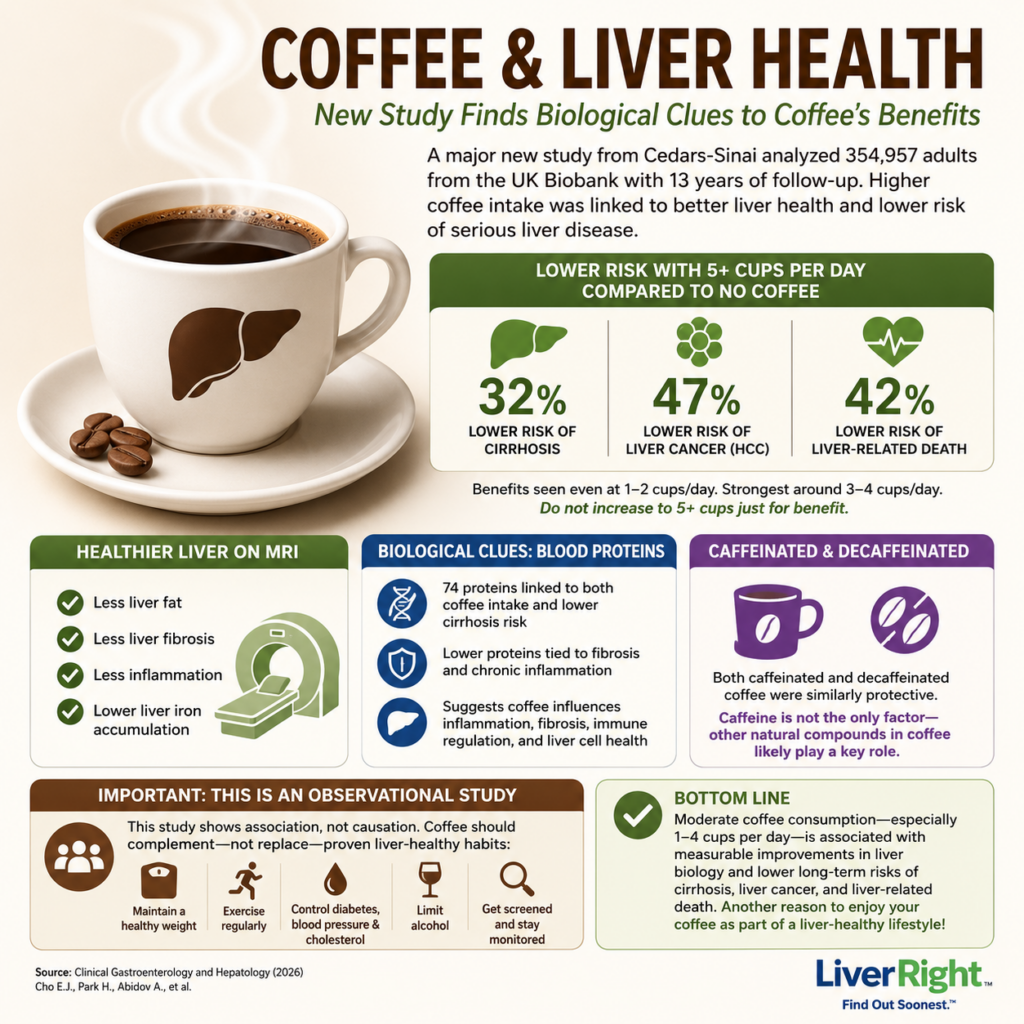
This new Clinical Gastroenterology and Hepatology (CGH) study is one of the strongest observational studies to date examining coffee and liver health because it combines long-term clinical outcomes with liver MRI imaging and blood proteomics, providing biologic clues—not just epidemiologic associations—to explain why coffee appears protective.
Summary
Researchers from Cedars-Sinai analyzed 354,957 adults from the UK Biobank who had no cirrhosis or liver cancer at enrollment. Participants were followed for a median of 13 years, allowing investigators to compare coffee consumption with future liver outcomes. A subset also underwent advanced liver MRI and blood protein analyses.
Major Findings
Compared with people who drank no coffee, those consuming five or more cups per day experienced:
- 32% lower risk of cirrhosis
- 47% lower risk of hepatocellular carcinoma (HCC)
- 42% lower risk of liver-related death
Importantly, the benefit was dose-dependent:
- Protective effects began with 1–2 cups/day
- Benefits appeared strongest around 3–4 cups/day
- The investigators do not recommend increasing intake to five or more cups simply because that group had the lowest observed risk.
New Biological Evidence
Unlike earlier studies, this work examined why coffee might be beneficial.
Participants with higher coffee intake demonstrated:
- Less liver fat
- Less liver fibrosis
- Less liver inflammation
- Lower liver iron accumulation on MRI
- Favorable blood protein patterns associated with healthy liver function
- Lower levels of proteins linked to fibrosis and chronic inflammation.
The proteomic analysis identified 74 proteins associated with both coffee consumption and cirrhosis risk, suggesting coffee influences pathways involved in:
- inflammation
- fibrosis
- immune regulation
- hepatocyte function.
Caffeinated vs. Decaffeinated
One of the more interesting findings was that both caffeinated and decaffeinated coffee showed similar protective associations.
This suggests that caffeine is probably not the only active ingredient. Other naturally occurring compounds in coffee—such as chlorogenic acids, polyphenols, diterpenes, and antioxidants—likely contribute to the observed liver benefits.
Important Caveats
The authors emphasize that this was an observational study, meaning it demonstrates an association but does not prove that coffee prevents liver disease.
Coffee should complement—not replace proven liver health strategies, including:
- maintaining a healthy weight
- treating obesity and diabetes
- exercising regularly
- limiting alcohol
- controlling blood pressure and cholesterol
- appropriate liver screening and surveillance.
Bottom Line
This is one of the most compelling studies yet linking coffee to liver health because it goes beyond showing that coffee drinkers have better outcomes. It demonstrates that higher coffee intake is associated with measurable improvements in liver biology, imaging, and molecular markers, providing plausible mechanisms for the lower risks of cirrhosis, liver cancer, and liver-related death observed over more than a decade of follow-up. While it does not establish causation, it substantially strengthens the evidence supporting moderate coffee consumption as part of an overall liver-healthy lifestyle.