
Summary of the article from Pitchbook titled “PitchBook Analyst Note: AI Will Deliver Care to Billions and Break the System That Built It.”
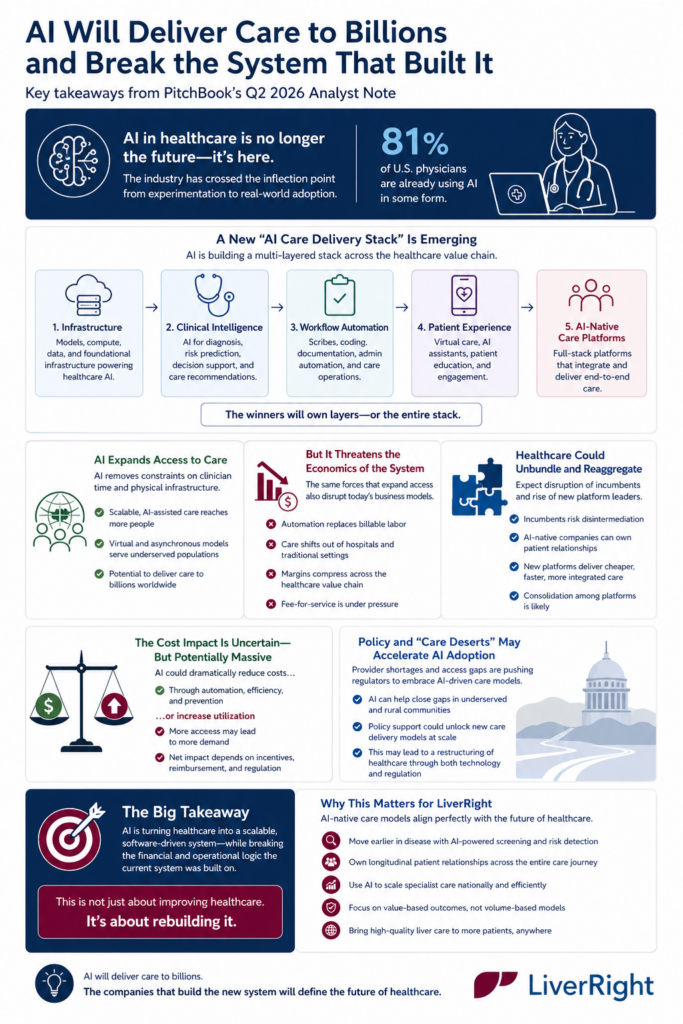
🧠 Core thesis
AI will massively expand access to healthcare (to “billions”)—but in doing so, it will fundamentally disrupt and potentially break today’s healthcare system and business models.
📊 Key points
1) AI adoption has already hit an inflection point
- ~81% of U.S. physicians are now using AI in some form.
- The industry has moved from experimentation to real deployment across care delivery.
👉 Translation: This is no longer early-stage hype—AI is becoming standard infrastructure.
2) A new “AI care delivery stack” is emerging
PitchBook frames healthcare AI as a multi-layer stack (like cloud or internet stacks), including:
- Infrastructure (models, compute, data)
- Clinical tools (decision support, diagnostics)
- Workflow automation (scribes, coding, admin)
- Patient-facing interfaces (virtual care, assistants)
- Full-stack care platforms
👉 The winners won’t just be point solutions—they’ll control entire layers (or the full stack).
3) AI dramatically expands access to care
- AI enables automation + scalability of clinicians, allowing care to reach far more patients.
- Virtual, AI-assisted, and asynchronous care models can serve populations previously excluded.
👉 This is how AI could “deliver care to billions”—by breaking the constraint of clinician time.
4) But it threatens the economics of the current system
The same forces that expand access also:
- Compress margins (automation replaces billable labor)
- Shift care outside traditional settings (hospital → home, async, digital)
- Reduce reliance on high-cost providers and intermediaries
👉 In short:
AI undermines fee-for-service, hospital-centric, labor-driven revenue models.
5) Healthcare could unbundle and reaggregate
- Incumbents (health systems, payers, pharma) risk disintermediation
- New entrants (AI-native companies) can:
- Own patient relationships
- Deliver cheaper, faster care
- Capture value across the stack
👉 Expect platform consolidation + new category leaders, similar to what happened in fintech or SaaS.
6) Cost impact is uncertain—but potentially massive
PitchBook models different scenarios:
- AI could significantly reduce costs through automation and prevention
- Or paradoxically increase utilization (more access → more demand)
👉 Net effect depends on incentives, reimbursement, and regulation.
7) Policy and “care deserts” may accelerate AI adoption
- Shortages of providers and access gaps (“care deserts”) may push regulators to embrace AI-driven care models.
👉 AI may not just be a tech shift—it could be a policy-enabled restructuring of healthcare delivery.