
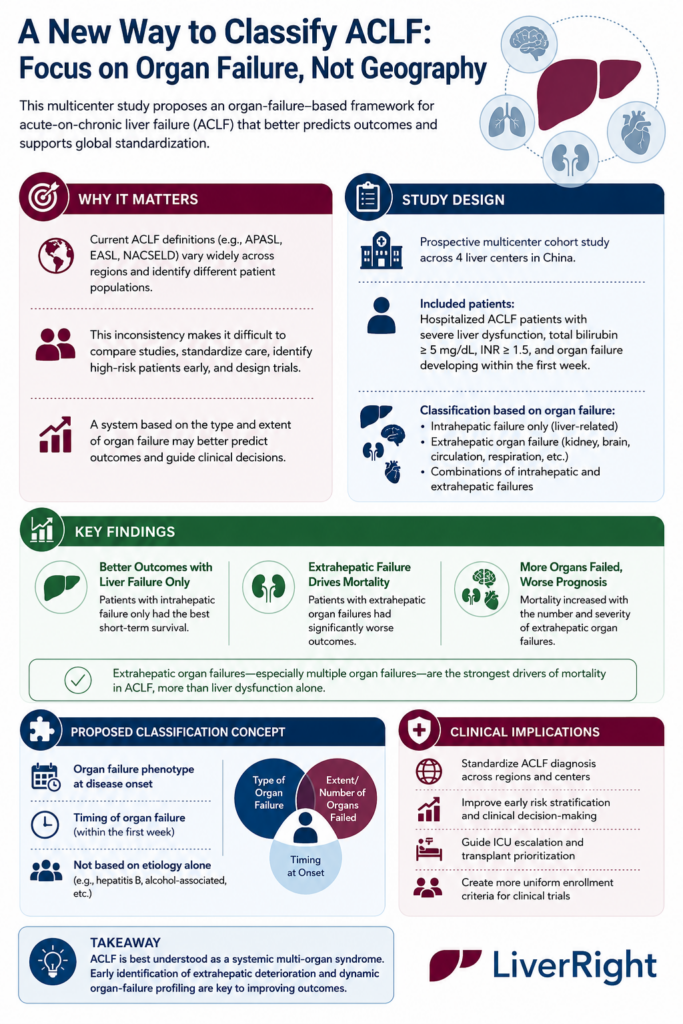
This paper titled “Organ failure-based clinical classification at onset of acute-on-chronic liver failure: a prospective multicenter cohort study” from Scientific Reports proposes a new way to classify acute-on-chronic liver failure (ACLF) based on which organs are failing during the first week after onset, rather than relying on existing regional definitions that vary widely across Asia, Europe, and North America.
Why this matters
Current ACLF definitions from groups like APASL, EASL, and NACSELD identify different patient populations and predict outcomes differently. That inconsistency makes it difficult to:
- compare studies,
- standardize clinical care,
- identify high-risk patients early,
- and design clinical trials.
Study design
Researchers conducted a prospective multicenter cohort study across four liver centers in China. They enrolled hospitalized ACLF patients who had:
- severe liver dysfunction,
- total bilirubin ≥ 5 mg/dL,
- INR ≥ 1.5,
- and organ failure developing within the first week.
The investigators classified patients according to whether they had:
- Intrahepatic failure only (primarily liver-related),
- Extrahepatic organ failure (kidney, brain, circulation, respiration, etc.),
- or combinations of both.
Key findings
The study found that the type and extent of organ failure strongly correlated with prognosis:
- Patients with only liver failure generally had better short-term survival.
- Patients with extrahepatic organ failures, especially multiple organ failures, had much worse outcomes.
- Extrahepatic failures appeared to drive mortality more than liver dysfunction alone.
The authors argue that early organ-failure profiling may provide a more clinically useful framework than current geographically specific ACLF definitions.
Proposed classification concept
The paper suggests an ACLF framework centered on:
- organ failure phenotype, and
- timing at disease onset,
rather than etiology alone (e.g., hepatitis B vs alcohol-associated liver disease).
Clinical implications
The proposed model could help:
- standardize ACLF diagnosis internationally,
- improve early risk stratification,
- guide ICU escalation and transplant prioritization,
- and create more uniform enrollment criteria for trials.
This study aligns with LiverRight’s focus on–
- early identification of decompensation risk, and
- dynamic phenotyping using organ-system data.
And it reinforces the importance of:
- longitudinal monitoring,
- identifying extrahepatic deterioration early,
- and using structured risk models beyond standard liver labs alone.
One especially important takeaway is that ACLF may be better understood as a systemic multi-organ syndrome, not just severe liver injury.