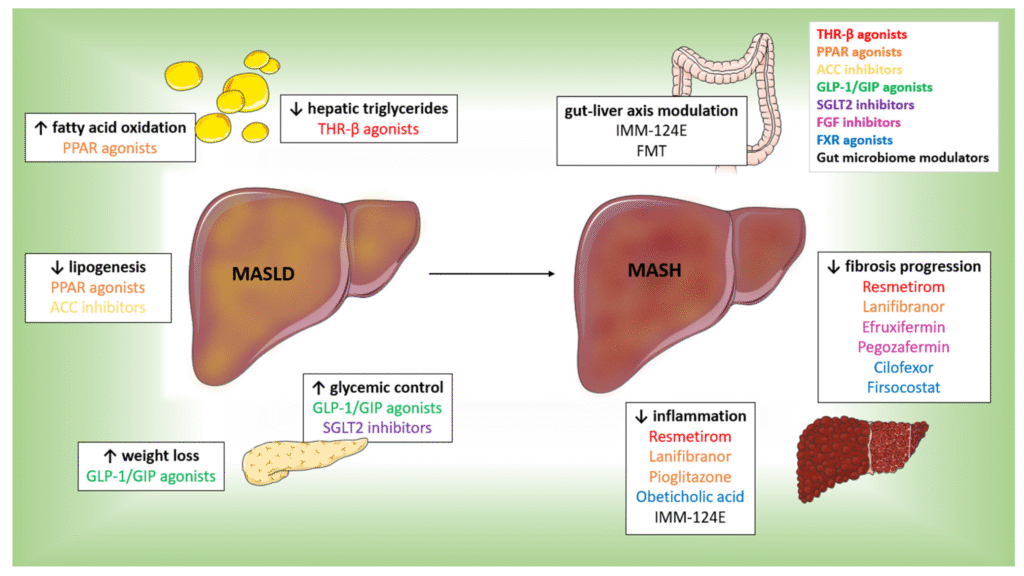
Here’s a breakdown of the nine (9) late‑stage MASH (metabolic dysfunction‑associated steatohepatitis) candidates from BioSpace’s article, summarized by each medication:
🔹 1. Survodutide (Boehringer Ingelheim)
- A dual GLP‑1/GIP receptor agonist currently in Phase III MASH trials (the LIVERAGE program, including patients with fibrosis and compensated cirrhosis).
- Boehringer has FDA breakthrough designation.
- Injects weight loss and metabolic benefits into the MASH space, leveraging its established effects in obesity and T2D
🔹 2. Tirzepatide (Eli Lilly)
- Another dual GLP‑1/GIP agonist—Lilly reported positive Phase II MASH data in June 2024.
- Showed MASH resolution (>50% of participants) without fibrosis worsening; 51–55% achieved ≥ one‑stage fibrosis improvement vs ~13% placebo
- Analysts expect GLP‑1s like tirzepatide to likely dominate MASH treatment
🔹 3. Semaglutide (Novo Nordisk)
- A GLP‑1 agonist in Phase III MASH trial (“ESSENCE”), with results anticipated by year‑end
- Considered by experts (like Nash) to be the front‑runner among GLP‑1s for FDA approval in MASH, potentially as early as late 2025/early 2026 .
🔹 4. Efimosfermin Alfa (Boston Pharmaceuticals)
- A long‑lasting FGF21 analog in serum based on IgG-FGF21 fusion, designed for once‑monthly dosing.
- November 2024 Phase II data showed one-stage fibrosis improvement without MASH worsening.
- Phase III expected to start in Q4 2025, including studies combining with GLP‑1s
🔹 5. Pegozafermin (89bio)
- Another FGF21 analog (BIO89‑100) in Phase III trials (“ENLIGHTEN‑Cirrhosis”).
- Aims at patients with compensated cirrhosis due to MASH; builds on promising metabolic and liver fat–reducing results
🔹 6. MSDC‑0602K (Cirius Therapeutics)
- A second‑generation oral insulin sensitizer targeting the mitochondrial pyruvate carrier (MPC), in Phase III.
- Early data show improved insulin sensitivity, lipid metabolism, and reduced inflammation.
- June 2024 data suggests combining MSDC‑0602K with GLP‑1s may help offset fat redistribution and muscle loss seen with GLP‑1 therapy alone
🔹 7. Denifanstat (Sagimet Biosciences)
- A fatty acid synthase (FASN) inhibitor in Phase III (“FASCINATE‑3”).
- Phase IIb studies demonstrated significant histologic MASH improvements and liver-fat reduction in patients with F2–F3 fibrosis and metabolic comorbidities
🔍 Key Takeaways:
- GLP‑1 agonists (survodutide, tirzepatide, semaglutide) dominate the most advanced stage candidates, with strong momentum in metabolic and hepatic benefit.
- FGF21 analogs (efimosfermin, pegozafermin) offer novel mechanisms and are moving into Phase III.
- Oral agents like MSDC‑0602K and denifanstat introduce non-injectable options focusing on insulin signaling and lipid synthesis pathways.
- Combination strategies—GLP‑1 paired with FGF21 or MPC modulators—are emerging as promising multipronged approaches.
🔹 8. Drug Name: Efruxifermin aka EFX (Akero Therapeutics)
Akero Therapeutics’ MASH (Metabolic dysfunction-associated steatohepatitis) drug candidate is efruxifermin (EFX), a fibroblast growth factor 21 (FGF21) analog. Here’s a summary of its development and clinical profile:
🔹 Mechanism of Action:
EFX is a long-acting analog of FGF21, a hormone involved in regulating metabolism, insulin sensitivity, lipid metabolism, and liver inflammation. It targets key mechanisms in MASH, including:
- Reducing liver fat
- Improving insulin resistance
- Decreasing inflammation and fibrosis
🔹 Clinical Development Highlights:
🔸 HARMONY (Phase 2b):
- Population: Biopsy-confirmed MASH with stage F1–F3 fibrosis.
- Results:
- 41–76% of patients achieved NASH resolution without worsening fibrosis.
- Up to 41% achieved a ≥1 stage fibrosis improvement without worsening NASH.
- Robust reductions in liver fat, ALT, AST, and biomarkers of fibrosis.
🔸 SYMMETRY (Phase 2b):
- Population: MASH with compensated cirrhosis (F4 fibrosis).
- Interim results (Week 36):
- Significant improvements in liver stiffness and biomarkers.
- Numerical reductions in fibrosis stage, but the primary histology endpoint was not met at 36 weeks.
- A 96-week biopsy readout is expected in Q4 2025.
🔹 Safety Profile:
- Generally well tolerated.
- Most common side effects: GI symptoms (mild to moderate).
- Low rate of treatment discontinuation.
🔹 Next Steps:
- Akero is expected to launch Phase 3 trials in non-cirrhotic MASH in 2H 2025.
- The SYMMETRY 96-week data will be crucial for positioning EFX for cirrhotic MASH.
🔹 Competitive Edge:
- One of the most promising FGF21 candidates.
- Differentiated by dual impact on both NASH resolution and fibrosis improvement.
- Strong efficacy in both early-stage and advanced (F4) MASH populations.
===============
🔹 9. Drug Name: VK2809 (Viking Therapeutics)
🔹 Drug & Mechanism
- VK2809 is an oral, liver‑targeted thyromimetic prodrug, selectively activating the thyroid hormone receptor-β (TRβ) to help regulate lipid metabolism in the liver.
🔹 Clinical Data – VOYAGE Phase 2b
- In biopsy-confirmed MASH patients, VK2809:
- Reduced liver fat by 37–55% at 52 weeks across all doses
- Achieved 44–57% fibrosis improvement at higher doses vs. 34% placebo
- Induced NASH resolution in 63–75% of patients without worsening fibrosis; placebo arm saw ~29% resolution
- Safety: Well tolerated overall—side effects like nausea and diarrhea were mild to moderate and similar to placebo; no hepatotoxicity or gallbladder issues .
🔹 Competitive Positioning
- Analysts (e.g., William Blair) view VK2809 as a best-in-class oral therapy in the MASH/NASH field, praising its dual impact on fibrosis and NASH resolution.
- Its oral route provides a practical advantage over injectable contenders.
🔹 Next Steps & Context
- Viking is evaluating registration options, possibly including a Phase 3 program centered on fibrosis stage 2–3 patients.
- Data was presented at AASLD in Nov 2024; no definitive Phase 3 launch date announced yet
- The therapy exists alongside Viking’s broader metabolic pipeline, including obesity and dyslipidemia drugs .
📊 How VK2809 Stacks Up
| Feature | VK2809 |
|---|---|
| Route | Oral, daily small molecule |
| Primary Mode | TRβ‑mediated reduction in liver fat and fibrosis |
| Liver fat reduction | 37–55% average at 52 weeks |
| Fibrosis improvement | 44–57% in high-dose arms |
| NASH resolution | 63–75% |
| Safety Profile | Mostly mild/moderate GI effects; no serious liver/gallbladder issues |
| Competitive edge | First oral agent with strong dual outcomes in both liver fat and fibrosis improvement |
Bottom line: VK2809 stands as a promising oral MASH therapy with compelling Phase 2b results showing notable reductions in liver fat, significant fibrosis improvements, and high NASH resolution rates. Its tolerability and oral dosage could position it strongly among upcoming MASH treatments—especially if Viking progresses toward Phase 3 in stages F2–F3.