This press release caught our attention, of course: “USC researchers find two understudied ‘forever chemicals’ raise liver cancer risk” from 11/19/2026.
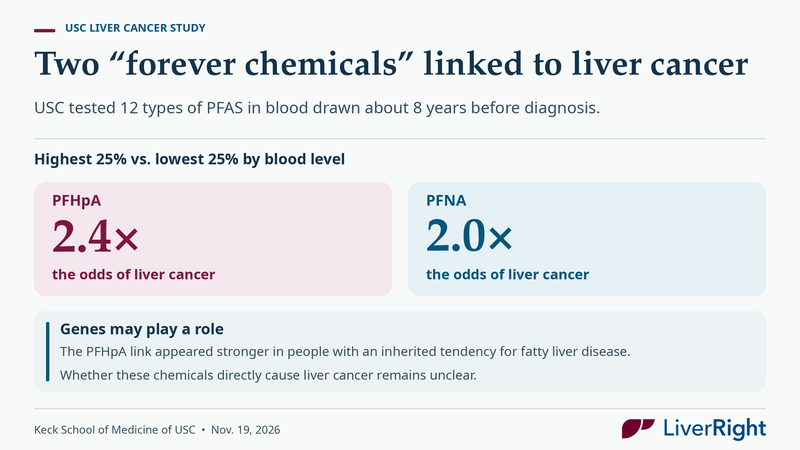
USC researchers compared 223 people who developed hepatocellular carcinoma (HCC) with 223 matched controls. Blood samples were collected an average of 7.8 years before diagnosis. People in the highest quarter of blood levels had roughly 2.5 times the odds of HCC for PFHpA and 2 times the odds for PFNA, compared with the lowest quarter for each chemical.
The genetic finding was specific to PFHpA. Its association with HCC appeared stronger in people genetically predisposed to fatty liver disease (MASLD). The evidence for that interaction depended on how exposure was analyzed, and the observational study could establish only an association.
The USC finding could matter sooner for drinking-water policy than for liver cancer screening. PFHpA is the chemical to watch most closely. A separate, larger U.S. study also linked it to liver cancer. The evidence for PFNA was weaker, and the finding that inherited fatty-liver risk may amplify the PFHpA link still needs confirmation.
| Area | Potential ramification |
|---|---|
| Drinking water and environmental health | The findings give regulators a reason to look beyond the two best-known PFAS, PFOA and PFOS. EPA included PFHpA in its recent national drinking-water monitoring program, and it has proposed rescinding the federal drinking-water limit for PFNA. The USC study adds evidence to that debate, though it does not establish what drinking-water level would raise liver cancer risk. epa.gov |
| Who gets screened for liver cancer | If larger studies confirm the gene–exposure link, researchers could test whether it identifies a subset of people with fatty liver disease who would benefit from surveillance. The missing number is absolute risk. Even twice the odds can translate into a small increase when the starting risk is low. For now, surveillance generally focuses on people with cirrhosis and certain people with chronic hepatitis B. A PFAS blood test measures exposure and cannot predict an individual’s liver cancer risk. |