Why early liver disease detection in U.S. adults is a clinical and financial necessity
Liver disease can develop quietly for years. By the time a patient feels sick, the opportunity for simpler, earlier treatment may have narrowed. For primary care practices, identifying liver disease before complications develop deserves a place alongside managing diabetes, blood pressure and cholesterol.
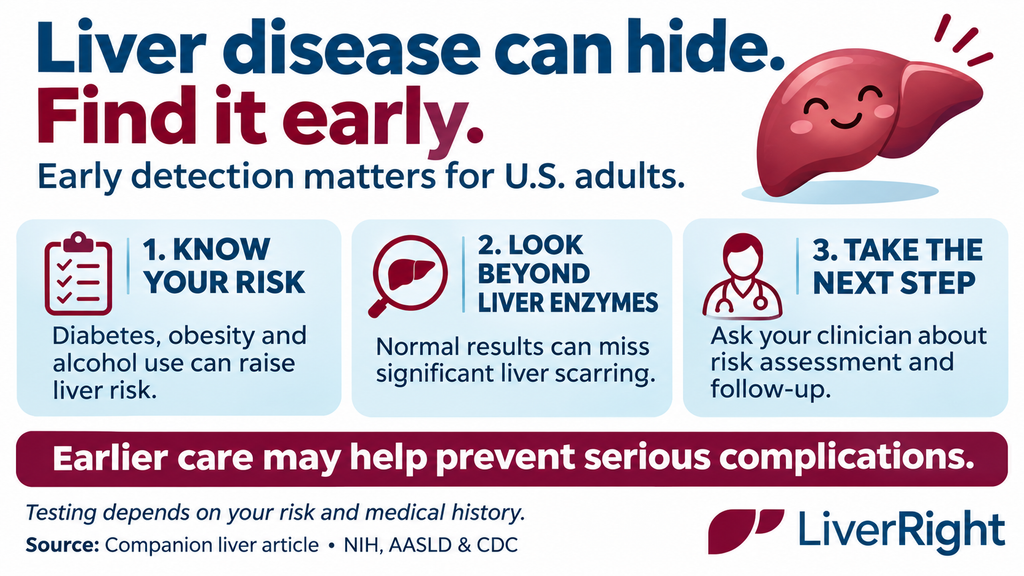
The opportunity is substantial. NIH estimates that roughly one in four U.S. adults has metabolic fatty liver disease, now commonly called MASLD. Some develop MASH, a more damaging form that can cause liver scarring, cirrhosis and liver cancer.
Routine bloodwork can leave important disease undetected
A patient can have significant liver scarring even when commonly measured liver enzymes are normal. And an imaging report that mentions “fatty liver” does not, by itself, establish how much damage has occurred.
The practical question is whether the patient has scarring that changes their risk—and their care. Liver guidelines recommend targeted assessment of higher-risk adults, including people with type 2 diabetes, obesity with metabolic complications, significant alcohol use or a family history of cirrhosis. They do not recommend universal fatty liver screening of the general population.
The first step can use information already available
For appropriate patients, primary care can calculate FIB-4 using age, two liver enzymes and a platelet count. It estimates the likelihood of advanced scarring; it does not diagnose every liver condition.
Patients with concerning or uncertain results can move to a liver stiffness test, such as FibroScan, or a specialized blood test such as ELF. Age and clinical circumstances affect interpretation. This staged approach helps identify who needs specialist attention while allowing many lower-risk patients to remain in primary care with periodic reassessment.
A comprehensive approach also looks beyond metabolic disease. CDC recommends at least one lifetime screening for hepatitis B and hepatitis C for U.S. adults, with additional testing in specified circumstances.
Earlier identification now opens more treatment options
Care can include weight management, physical activity, alcohol reduction and treatment of associated metabolic conditions. Eligible adults with noncirrhotic MASH and moderate-to-advanced scarring also have FDA-approved medication options, including Rezdiffra and Wegovy. Their accelerated approvals are based on improvements in liver inflammation and scarring; longer-term clinical benefits remain under evaluation.
The financial case strengthens as disease advances
When cirrhosis progresses to serious complications, costs rise substantially. A U.S. insurance claims study found approximately twice the costs for decompensated cirrhosis—when serious complications develop—compared with compensated cirrhosis.
For health systems and payers, this supports investing in earlier identification and effective treatment. Actual savings depend on which patients are reached, treatment costs and whether progression is prevented.
The missing piece is a reliable path from detection to care
A flagged laboratory result needs an owner. A patient needs help completing testing, understanding the diagnosis and starting appropriate care.
Primary care and liver specialists can build that pathway together, with telemedicine supporting access where local appointments are difficult to obtain.
The goal is straightforward: identify adults at risk, establish how much liver damage is present, and act while there is still time to change its course.