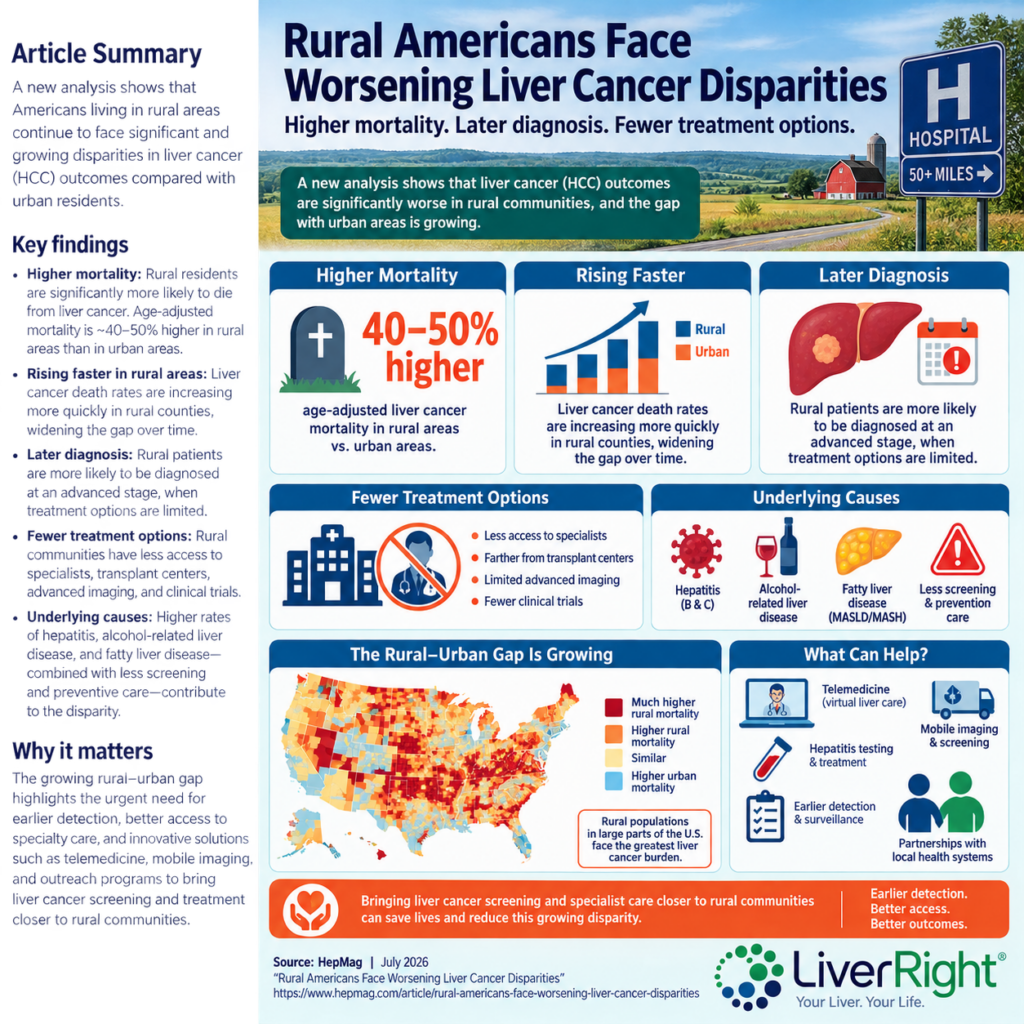

The HepMag article from 08/27/2026 titled “Rural Americans Face Worsening Liver Cancer Disparities” is revealing.
The article highlights a growing rural–urban divide in hepatocellular carcinoma (HCC), the most common form of primary liver cancer. It is based on a large national study of 264,633 HCC cases diagnosed from 2001 through 2022. While liver cancer trends have improved in many urban areas, rural communities have not experienced the same progress.
Among rural men, HCC incidence increased by about 1.1% per year from 2007–2022, while incidence among urban men fell about 1.4% per year beginning in 2008. The difference was also striking for women: rural incidence rose about 1.7% annually from 2001–2022, while urban rates began declining after 2009.
The mortality trends may be even more concerning. Among men living in rural counties, HCC-related mortality increased about 1.2% per year, while it declined approximately 1.4% annually in urban counties. Among women, rural mortality was essentially unchanged while urban mortality declined about 1% per year. In other words, urban America is increasingly benefiting from improvements in liver cancer prevention and treatment, while rural America is being left behind.
The disparity is also visible across stages of cancer. For example, distant-stage HCC incidence among rural men increased about 1.9% annually from 2007–2022, while it declined in urban men. Researchers point to several likely contributors, including higher prevalence of obesity, diabetes, MASH/MASLD, alcohol-associated liver disease and viral hepatitis, combined with poorer access to screening, specialty liver care, advanced imaging and treatment.
The central message is that this is increasingly an access and early-detection problem, not simply a difference in underlying disease prevalence. The researchers call for targeted rural strategies emphasizing liver-disease prevention, identification of high-risk patients, HCC surveillance and improved access to specialized care.
For LiverRight, the findings are especially relevant: our national telehepatology model could help close exactly this geographic gap by identifying high-risk rural patients, getting them into specialist care earlier, ensuring appropriate ultrasound/AFP surveillance and follow-up imaging, and reducing the dependency on having a hepatologist physically located nearby. The opportunity is essentially to make distance from a liver center less predictive of whether HCC is found early enough to treat effectively.