“WASHINGTON, D.C. — August 27, 2026 — The U.S. Department of Health and Human Services (HHS) today announced the nine winners of the 2026 KidneyX EMPOWER: Living Link Prize Challenge, a $4 million national competition to accelerate innovation supporting living kidney donors and patients who depend on them. The challenge was run through the Kidney Innovation Accelerator (KidneyX), a public-private partnership between HHS and the American Society of Nephrology (ASN).”
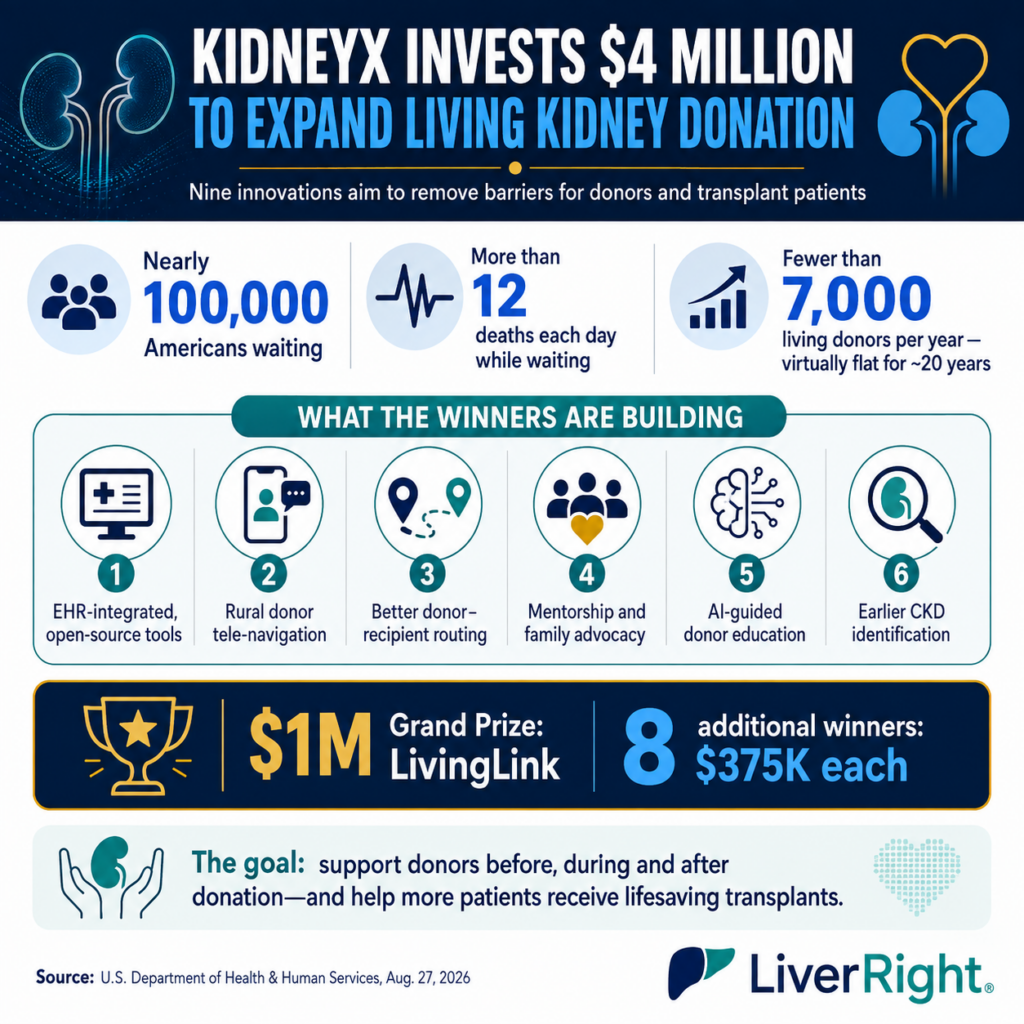
HHS announced nine winners of the 2026 KidneyX EMPOWER: Living Link Prize Challenge, a $4 million competition focused on expanding living kidney donation. The program attracted more than 85 submissions and is operated through KidneyX, a partnership between HHS and the American Society of Nephrology.
The need is substantial: nearly 100,000 Americans are waiting for a kidney transplant, and more than a dozen die each day while waiting. Despite this demand, living kidney donation has remained below 7,000 donors annually—and essentially unchanged—for roughly two decades. Financial, logistical, educational and social barriers continue to prevent willing donors from proceeding.
The $1 million grand prize went to LivingLink, an open-source platform designed to integrate directly with electronic health records using HL7 FHIR standards. Eight additional teams received $375,000 each. Their solutions include rural tele-navigation, improved donor–recipient routing, identification of people who may be ready to donate, individualized evaluation of older donors, peer mentoring, family advocacy programs, AI-supported donor education and EHR-based identification of patients with chronic kidney disease.
Collectively, the projects are intended to support donors before, during and after donation while helping more patients obtain lifesaving transplants. The announcement also illustrates a broader federal emphasis on interoperable data, virtual care, patient navigation and earlier identification of eligible patients and donors.