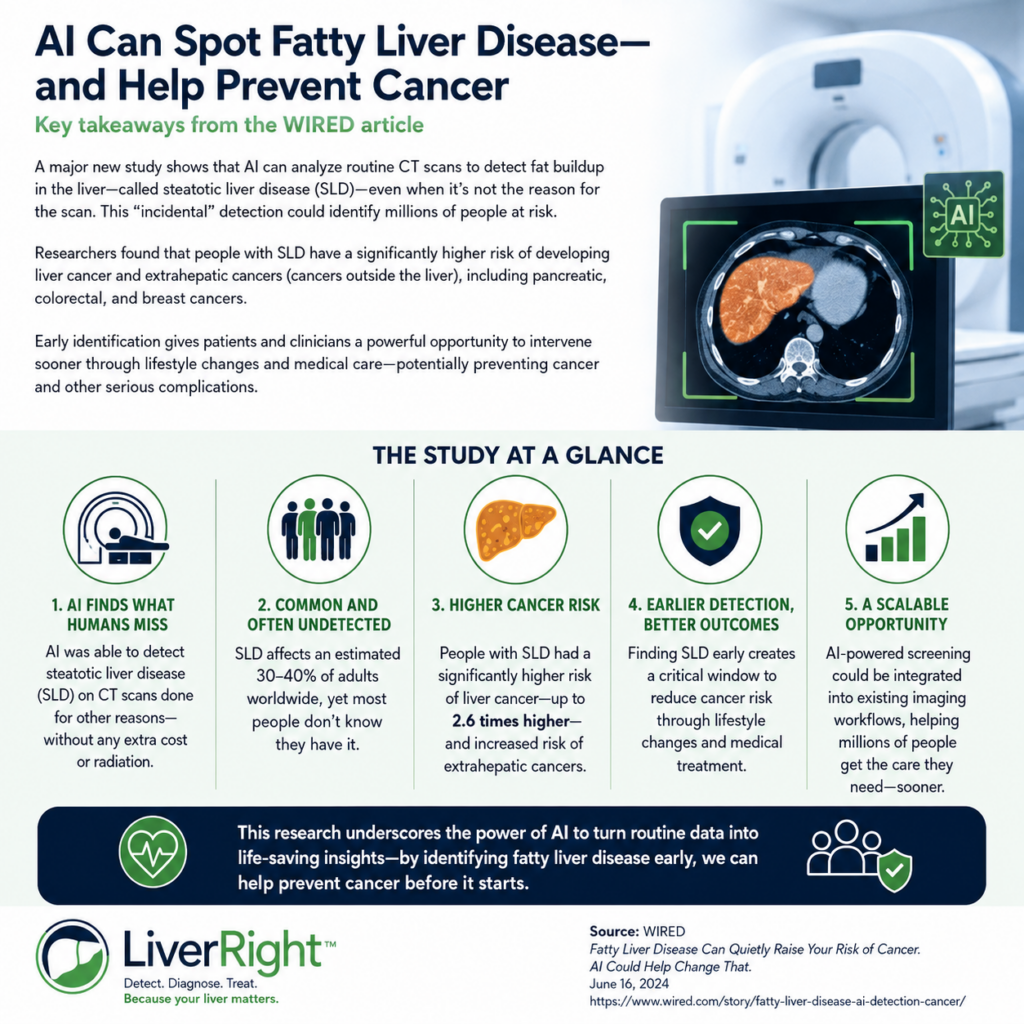
The 08/13/2026 WIRED article titled “There’s a Fatty Liver Epidemic. AI Could Help Get Ahead of It” argues that fatty liver disease has become a massive, largely silent public-health problem: more than a billion people worldwide have excess liver fat, and roughly 30% of adults are affected. Because the disease often causes few or no symptoms until fibrosis or cirrhosis is advanced, many patients are diagnosed only after substantial damage has occurred. Yet the liver is unusually capable of recovery, making early identification especially valuable: lifestyle changes can reverse early inflammation and scarring, while newer therapies such as resmetirom and semaglutide are expanding treatment options for patients with more significant disease.
The central opportunity is not necessarily inventing a brand-new diagnostic test—it is using AI to extract more value from data health systems already have. Researchers envision algorithms continuously reviewing electronic health records, routine laboratory results, and imaging to identify people who deserve further evaluation. One example is automatically calculating FIB-4 from existing clinical data rather than depending on a clinician to remember to do it. Another study described in the article used AI to detect fatty liver from routine chest X-rays, even though the scans were ordered for other purposes, with reported accuracy of 82%.
The article also highlights newer AI-based risk models that may improve on conventional screening. Evido’s LiverPRO uses age plus nine routine blood biomarkers and reportedly outperformed FIB-4 in a dataset of more than 470,000 people. Another model, ALADDIN, was designed to help identify patients most likely to benefit from resmetirom. The likely near-term role for these tools is therefore not replacing hepatologists, imaging, or biopsy; it is acting as a smarter first-pass screening layer in primary care—finding moderate- and high-risk patients earlier while reducing unnecessary specialist referrals.
The broader takeaway is that fatty liver disease may be particularly well suited to AI-enabled population health: the condition is common, underdiagnosed, often detectable using information already buried in the medical record, and far more treatable when caught early. That creates both a clinical and economic case for health systems to move from waiting for advanced liver disease to proactively finding at-risk patients before cirrhosis develops.