Summary
The June 19, 2026 articled titled “Spatial transcriptome mapping identifies Ppara-Anxa2 cross-talk in microplastic-induced hepatotoxicity” is edifying.
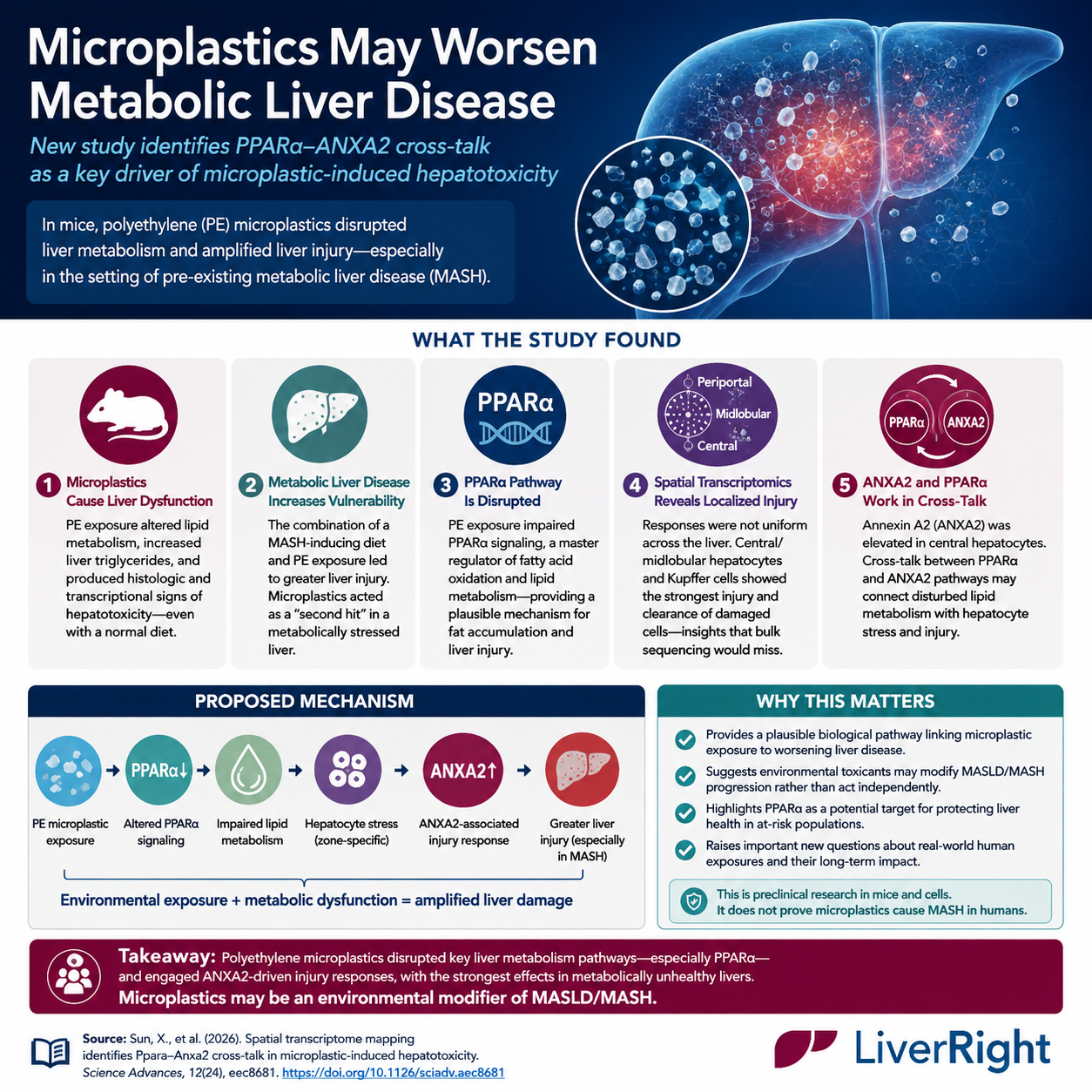
A new preclinical study suggests that polyethylene (PE) microplastics may directly disrupt liver metabolism and worsen metabolic liver injury, particularly when the liver is already under metabolic stress.
Researchers exposed mice to polyethylene microplastics while feeding them either a normal diet or a diet designed to induce MASH. After eight weeks, microplastic exposure produced evidence of liver toxicity even in mice on the normal diet, including increased steatosis and changes in genes involved in lipid metabolism. The effects were more pronounced when microplastic exposure was combined with the MASH-inducing diet, suggesting that microplastics may act as a “second hit” that amplifies injury in an already metabolically unhealthy liver.
One of the most interesting aspects of the study was the use of spatial transcriptomics, which allowed investigators to see where molecular changes were occurring within the liver rather than averaging gene expression across the entire organ. The analysis revealed distinct areas of inflammation and injury and showed that different populations of hepatocytes responded differently to microplastic exposure. These localized effects would have been difficult to detect using conventional bulk RNA sequencing alone.
The researchers identified PPARα, a major regulator of fatty-acid oxidation and lipid metabolism, as an important part of the response. They also demonstrated a relationship between PPARα and annexin A2 (ANXA2), a protein involved in cellular stress, damage response and tissue repair. Experimental inhibition or silencing of PPARα prevented the microplastic-induced increase in ANXA2, providing mechanistic evidence for a PPARα–ANXA2 signaling axis in the liver’s response to polyethylene exposure.
Why this matters for MASLD/MASH
The study raises an intriguing possibility: environmental exposures may influence the progression of metabolic liver disease rather than simply existing alongside traditional metabolic risk factors.
MASLD and MASH are generally viewed through the lens of obesity, insulin resistance, diabetes, dyslipidemia and other cardiometabolic drivers. These findings suggest that environmental toxicants such as microplastics could potentially interact with those underlying abnormalities and make a vulnerable liver more susceptible to injury.
That doesn’t mean microplastics have been shown to cause MASH in people. This was primarily a mechanistic study in mice and liver cells, and the exposure conditions cannot simply be translated into typical human exposure. The investigators themselves note that further work is needed to understand the relevance to human disease and whether the PPARα–ANXA2 pathway ultimately represents a therapeutic target.
Bottom line: The study provides a plausible biological mechanism by which polyethylene microplastics could disturb hepatic lipid metabolism and amplify liver injury, with the strongest effects occurring in metabolically stressed livers. It adds to the emerging idea that MASLD/MASH progression may reflect not only metabolic risk, but also interactions between metabolic dysfunction and environmental exposures.