
The article titled “Hepatitis C Treatment Could Save Billions” explains that expanding access to HCV treatment—especially among Medicaid patients—could generate major long-term healthcare savings while dramatically improving patient outcomes.
Key Takeaways
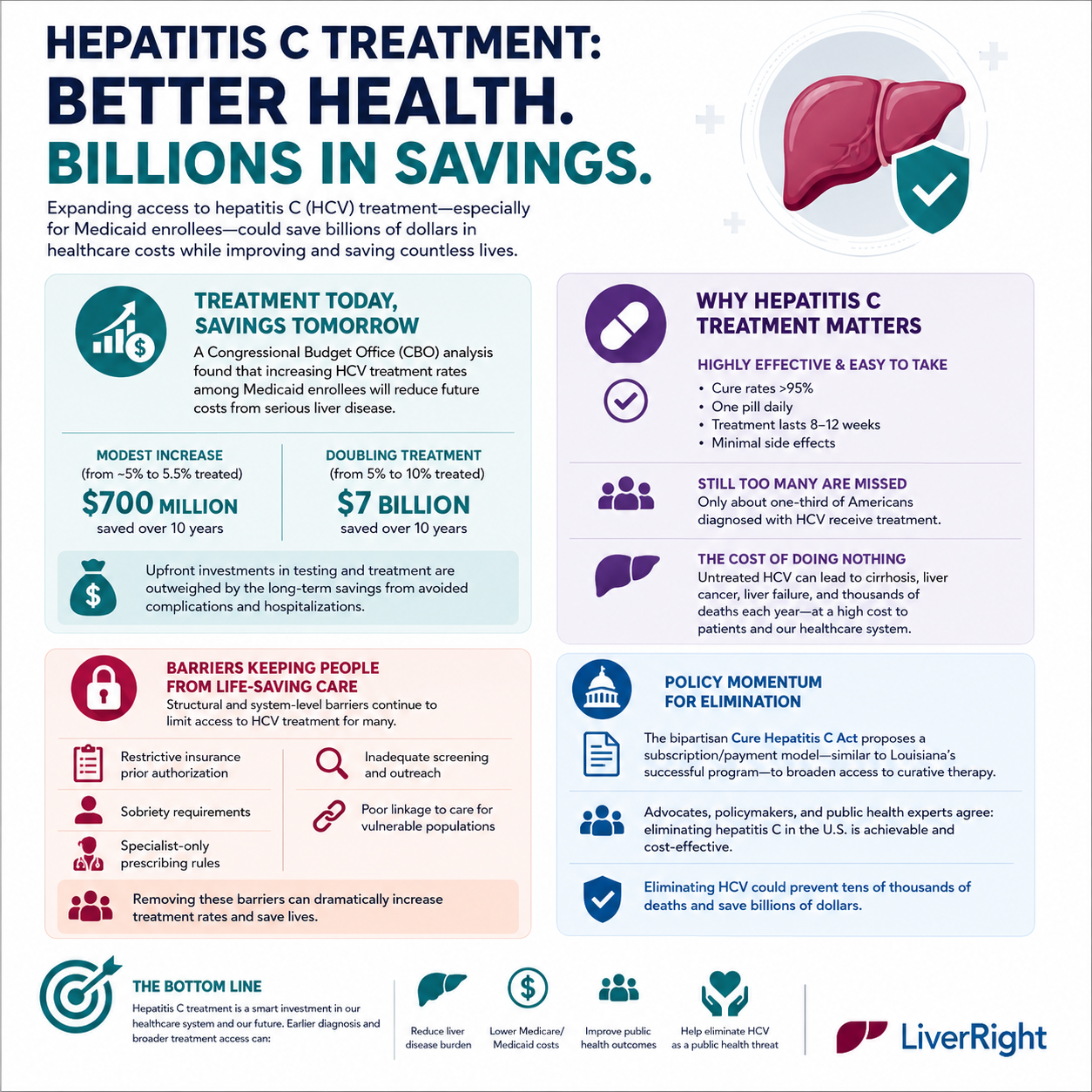
- A Congressional Budget Office (CBO) analysis found that increasing HCV treatment rates among Medicaid enrollees would reduce future healthcare spending on complications like cirrhosis, liver cancer, and liver failure.
- The report modeled two scenarios:
- Raising treatment rates modestly (from ~5% to 5.5%) could save about $700 million over 10 years.
- Doubling treatment rates (from 5% to 10%) could save roughly $7 billion over 10 years.
- Although treatment expansion would require additional upfront spending on testing and antiviral therapy, the avoided downstream costs would outweigh those investments.
Why Hepatitis C Treatment Matters
- Modern direct-acting antivirals (DAAs) cure more than 95% of cases, usually with:
- one pill daily,
- treatment durations of 8–12 weeks,
- minimal side effects.
- Despite this, only about one-third of Americans diagnosed with HCV receive treatment.
- Untreated HCV leads to costly complications and contributes to thousands of deaths annually.
Structural Barriers Highlighted
The broader discussion around the article points to persistent barriers:
- restrictive insurance prior authorization,
- sobriety requirements,
- specialist-only prescribing rules,
- inadequate screening and outreach,
- poor linkage to care for vulnerable populations.
Policy Momentum
The article also aligns with growing bipartisan interest in national HCV elimination strategies:
- The proposed Cure Hepatitis C Act would use a subscription/payment model similar to Louisiana’s program to broaden access to curative therapy.
- Advocates argue that eliminating HCV nationally could save billions while preventing tens of thousands of deaths.
Bottom Line
The central argument is that hepatitis C treatment is no longer just a clinical imperative—it is also a strong economic investment. Earlier diagnosis and broader treatment access could:
- reduce liver disease burden,
- lower Medicare/Medicaid costs,
- improve public health outcomes,
- and potentially help eliminate hepatitis C as a national public health threat.