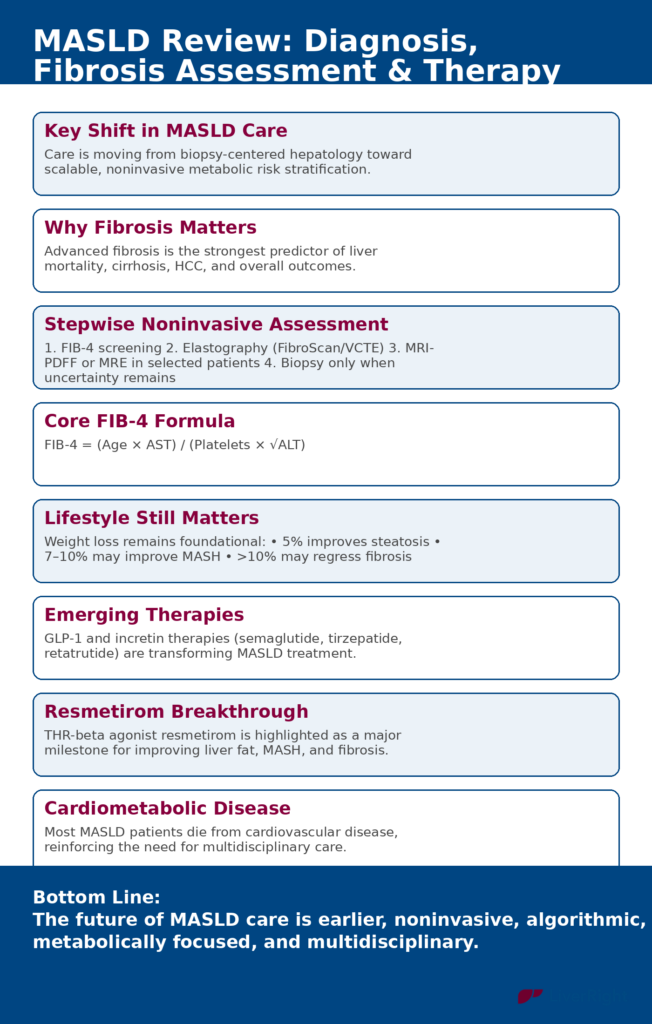
This May 16, 2026 Cureus review titled “Metabolic Dysfunction-Associated Steatotic Liver Disease: Current Diagnostic Pathways, Noninvasive Fibrosis Assessment, and Therapeutic Strategies” is essentially a “state of the field” overview of MASLD (formerly NAFLD) — covers how the disease is diagnosed today, how fibrosis should be assessed noninvasively, and where treatment is heading.
Core framing
The paper emphasizes that MASLD is now understood as a metabolic disease with hepatic manifestations, tightly linked to:
- obesity
- insulin resistance
- type 2 diabetes
- dyslipidemia
- cardiovascular disease
It highlights the terminology shift:
- NAFLD → MASLD
- NASH → MASH
The authors argue the new nomenclature better reflects underlying metabolic dysfunction and reduces stigma.
Main points from the paper:
1. Most patients are asymptomatic — fibrosis risk is what matters
The review stresses that simple steatosis is common, but advanced fibrosis is the key predictor of:
- liver-related mortality
- cirrhosis
- HCC
- transplant risk
- overall mortality
This is why modern care pathways focus less on “who has fat in the liver” and more on:
“Who has clinically significant fibrosis?”
2. Noninvasive fibrosis assessment is now central
A major theme is the transition away from routine liver biopsy.
The paper describes a stepwise risk stratification model now recommended by major societies.
First-line testing: FIB-4
The article strongly supports FIB-4 as the initial triage tool because it is:
- cheap
- scalable
- available from routine labs
The pathway is basically:
FIB4=Platelets×ALTAge×AST
General interpretation:
- low FIB-4 → low risk
- indeterminate/high FIB-4 → further testing
The review notes limitations:
- weaker performance in younger patients
- age-related false positives in older adults
- less accurate in acute inflammation
The paper aligns with broader guideline recommendations that FIB-4 should be the “front door” screening tool in primary care and endocrinology settings.
Second-line testing: elastography + advanced biomarkers
If FIB-4 is abnormal, the article recommends:
- transient elastography (FibroScan/VCTE)
- ELF test
- MRI-based methods in selected patients
FibroScan/VCTE
Highlighted as:
- accessible
- rapid
- scalable
- good for identifying advanced fibrosis
But the paper notes limitations:
- obesity can reduce accuracy
- operator dependence
- less precise in intermediate fibrosis stages
MRI-PDFF and MRE
The article presents MRI-based tools as the most accurate noninvasive modalities.
MRI-PDFF
Useful for:
- quantifying liver fat
- monitoring treatment response
Magnetic Resonance Elastography (MRE)
Presented as the most accurate noninvasive fibrosis test currently available.
The paper notes MRE outperforms many serum markers and transient elastography for advanced fibrosis detection.
3. Liver biopsy is no longer the routine default
The review repeatedly emphasizes:
- biopsy remains the gold standard
- but should be reserved for selected cases
Main biopsy indications:
- diagnostic uncertainty
- discordant noninvasive tests
- suspected advanced disease
- clinical trial enrollment
The paper frames the future as:
“biopsy-light” rather than “biopsy-free.”
4. Lifestyle intervention is still the foundation of therapy
Despite excitement around drugs, the review stresses:
- weight loss remains the most effective foundational intervention
Key points:
- 5% weight loss → improves steatosis
- 7–10% → may improve inflammation/MASH
- 10% → can regress fibrosis in some patients
The article emphasizes:
- Mediterranean diet
- exercise independent of weight loss
- resistance + aerobic training
- management of metabolic syndrome
It also notes long-term maintenance is difficult in real-world practice.
5. GLP-1 and incretin therapies are changing the field
A major section reviews emerging pharmacologic therapies.
The article is especially bullish on:
- GLP-1 receptor agonists
- dual/triple incretin agonists
Key agents discussed:
- semaglutide
- tirzepatide
- retatrutide
The review says these drugs improve:
- weight
- insulin resistance
- liver fat
- MASH resolution rates
But it notes fibrosis improvement is still less robust than MASH resolution in many trials.
The paper frames incretin therapy as likely becoming:
“core metabolic treatment for MASLD.”
6. Resmetirom is presented as a major milestone
The article highlights thyroid hormone receptor-beta agonist therapy — especially resmetirom — as the first major targeted MASLD/MASH therapy breakthrough.
Main claimed benefits:
- reduction in liver fat
- improvement in fibrosis
- improvement in MASH histology
The review portrays resmetirom as proof that:
targeted antifibrotic/metabolic liver therapies can work clinically.
7. MASLD is fundamentally a cardiovascular disease problem too
One of the paper’s strongest themes:
- most MASLD patients die from cardiovascular disease, not liver failure
So the authors argue treatment should include:
- lipid management
- diabetes control
- BP control
- statins
- weight reduction
- exercise
The paper pushes a multidisciplinary care model involving:
- hepatology
- endocrinology
- primary care
- cardiology
- obesity medicine
Overall takeaway
The review’s central message is:
MASLD management is moving from liver biopsy-centered hepatology care to scalable metabolic risk stratification using noninvasive fibrosis tools and systemic metabolic therapies.
The field is shifting toward:
- broad primary-care screening
- FIB-4-based triage
- elastography confirmation
- early fibrosis identification
- metabolic therapy + weight loss
- incretin and targeted liver drugs
The article strongly supports the idea that the future of MASLD care is:
o Metabolically focused rather than liver-only focused
o Earlier
o Noninvasive
o Algorithmic
o Multidisciplinary.
—