Major Headline from March 10, 2026:
Johns Hopkins leads $24M multinational consortium to find hepatitis B cure
With NIH funding, the group will pursue research and patient care approaches for a disease that affects more than 250 million people around the globe
Big picture:
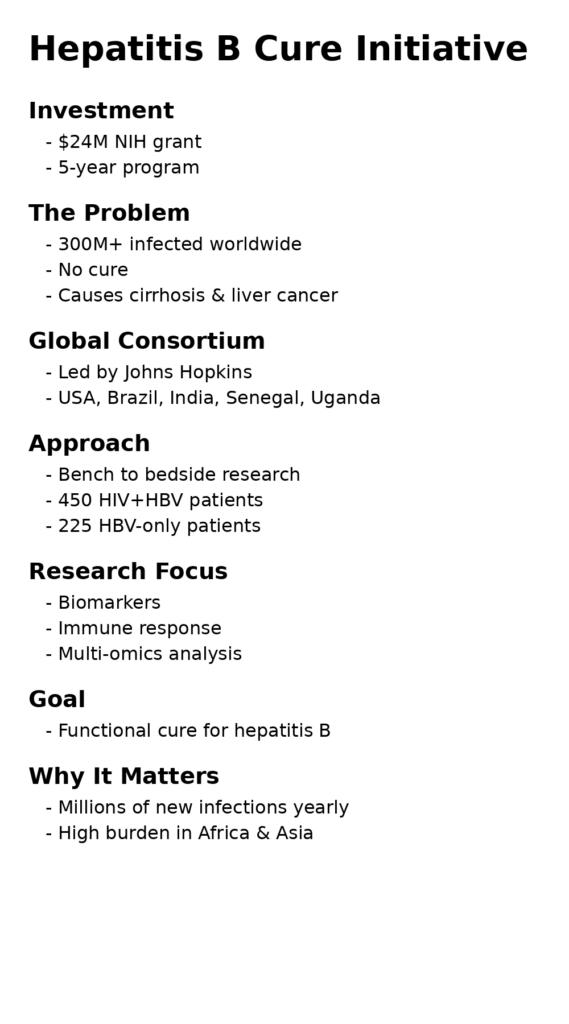
Johns Hopkins is leading a $24 million, 5-year global research consortium to find a cure for hepatitis B—a disease that still affects hundreds of millions worldwide.
Key points
- Funding & leadership
- $24M grant from NIH (NIAID)
- Led by Johns Hopkins Medicine
- The problem
- Hepatitis B is currently incurable
- ~300 million people infected globally
- Causes cirrhosis and liver cancer
- The consortium (BICC)
- Multinational collaboration: U.S., Brazil, India, Senegal, Uganda
- Combines research + clinical care (“bench to bedside”)
- Research strategy
- Build a large patient cohort:
- 450 patients with HIV + HBV
- 225 with HBV only
- Collect blood, liver tissue, immune cells
- Identify biomarkers and immune responses to guide cure development
- Build a large patient cohort:
- Scientific approach
- 7 coordinated components (virology, clinical, immunology, multiomics, etc.)
- Focus on:
- How HBV replicates
- How the immune system controls it
- What signals a “functional cure”
- Why it matters
- Vaccine exists, but access is uneven globally
- Millions still get infected every year
- A cure would be a major global health breakthrough.