
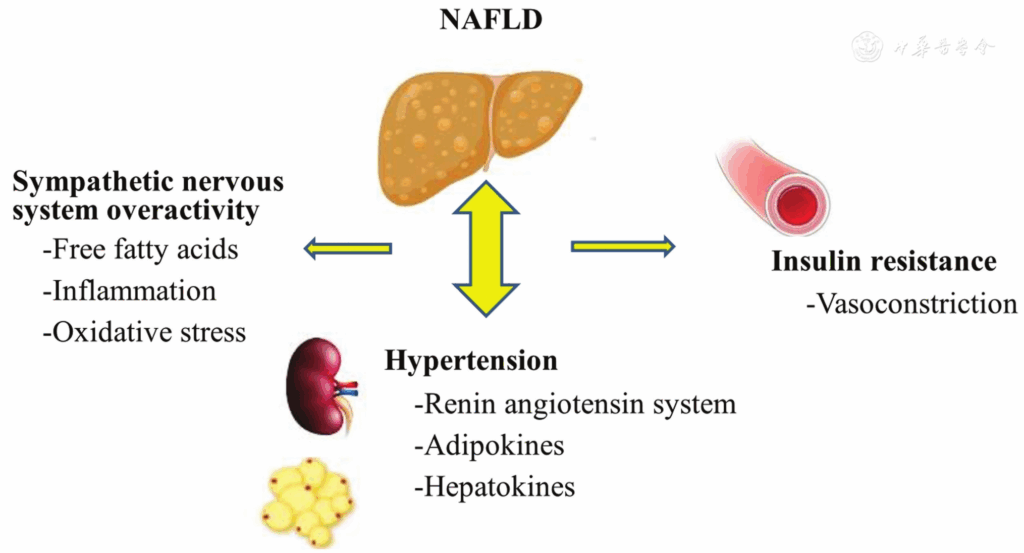
The May 2025 article “Prediction of Hypertension Risk in Patients with Fatty Liver Disease Using the Triglyceride-Glucose-Body Mass Index” shows the link between Hypertension (HTN) patients and Fatty Liver Disease (FLD).
Key quote: “FLD and HTN exhibit a bidirectional relationship: FLD elevates HTN risk, while HTN accelerates FLD progression to fibrosis.”
Objective
The study aimed to develop a nomogram (a visual, point-based prediction tool) to estimate the individualized risk of high blood pressure (hypertension) in elderly patients (≥60 years old) with non-alcoholic fatty liver disease (NAFLD). It was framed from a health management perspective to support early intervention and community-based management efforts.
Study Design & Methods
- A total of 7,319 elderly individuals (aged 60 and above) diagnosed with NAFLD (in Shanghai, China) were included.
- Predictive factors were identified using:
- LASSO regression (Least Absolute Shrinkage and Selection Operator)
- Random Forest modeling
- Followed by multivariate logistic regression to build the model.
- Results were visualized using a dynamic nomogram.
- Model evaluation included:
- Discrimination (ability to distinguish between those who will and won’t develop hypertension)
- Calibration (agreement between predicted and observed risk)
- Clinical utility through Decision Curve Analysis (DCA) and the Net Reclassification Index (NRI).
Key Predictors Identified
The final model highlighted the following significant predictors of hypertension risk among elderly NAFLD patients:
- Age
- Systolic Blood Pressure (SBP)
- Body Mass Index (BMI)
- Alanine Aminotransferase (ALT)
- Urea
- Uric Acid
- Neutrophil Count
These variables were incorporated into the nomogram to estimate individual risk.
Model Performance
- The discrimination of the model was described as moderate.
- Performance statistics:
- Internal validation AUC (Area Under the ROC Curve): ~0.707 (95% CI: 0.688–0.727)
- External validation AUC: ~0.688 (95% CI: 0.672–0.705)
- Calibration was good, and decision curve analysis indicated meaningful clinical utility.
- NRI (Net Reclassification Index): 0.109—suggesting improved classification versus standard approaches.
The Net Net
This study developed a clinically practical nomogram to predict early hypertension risk in elderly patients with NAFLD. Using readily available clinical and laboratory measures, the model shows moderate predictive accuracy and could help healthcare providers in community and preventative settings identify high-risk individuals sooner—potentially improving management through personalized interventions.